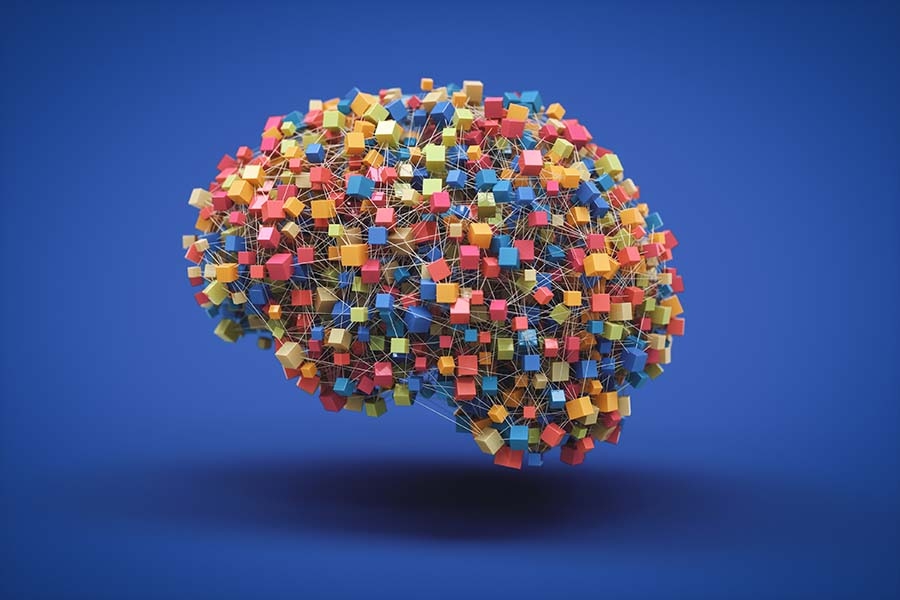
As artificial intelligence becomes more and more powerful, its ability to handle human-like tasks is undeniable. Artificial neural networks can learn to recognize images, use language, or write computer code. Like the brain’s circuits, they reorganize themselves as they learn, adjusting the strengths of their connections to improve their performance.
The question for many neuroscientists is: What can these machine systems teach them about how the brain learns? And what kinds of models are likely to be the most informative?
In a paper published Oct. 9 in the journal PNAS, scientists at MIT’s McGovern Institute for Brain Research and K. Lisa Yang Integrative Computational Neuroscience (ICoN) Center argue that a crucial metric for the biological plausibility of an artificial neural network’s approach to learning is the network’s ability to organize itself, without the guiding hand of a developer. They show that it is possible for an artificial neural network to build its own learning machinery. With some simple instructions about how and when connections should change, a group of randomly connected units can reshape itself into an effective information-processing network, learning from the data it is trained on.
When it comes to training AI to do its job, the approach is powerful. But Liao and his colleagues caution that networks designed in this way may not offer much insight into biological learning. “The brain doesn't have an external designer or architect,” Liao says. “The brain has to organize itself.
Source link