Coding agents now ship whole features in one sitting often spanning tens of thousands or hundreds of thousands of lines of code. As a result, reading every line of the pull request doesn’t scale to this new way of work. Now, most teams invest in the plan and relevant testing instead: describe to an agent what they want, go back and forth until the plan and proposed tests look right, and hand them off to the agent for implementation.
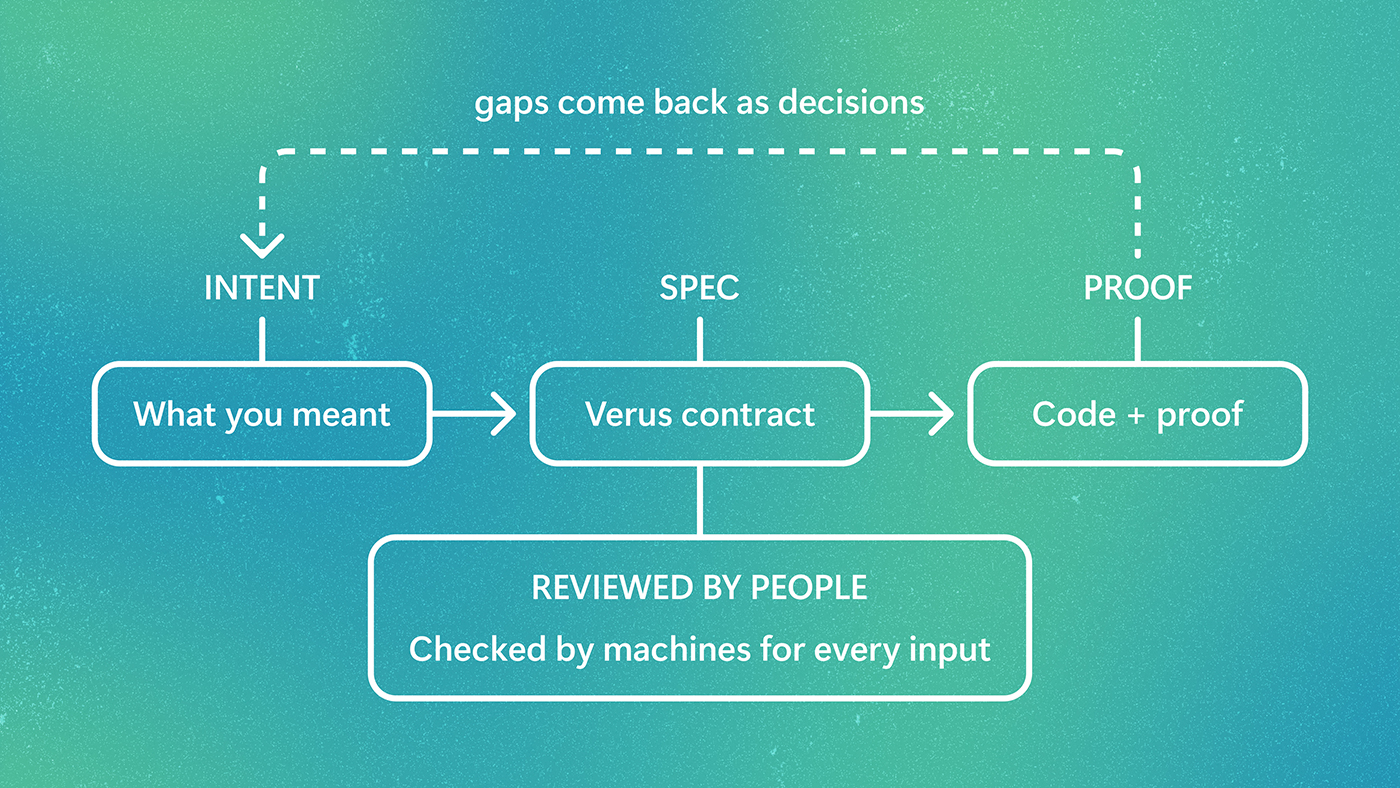
This plan or natural language spec is meant to be the contract that an agent holds. However, in practice, the agent can drift from it. It implements something slightly different, then writes tests that pass for its implementation rather than the code you intended it to write. Continuous integration (CI) grows due to a profusion of low quality and high quantity of tests, coverage looks healthy, and the gap between what you asked for and what shipped stays hidden until a bug report or a nasty edge case shows up.
So, how do you reliably scale review as agents generate increasingly large amounts of code? Agent code fails in two ways a careful reviewer would usually catch: it leaves out something obviously necessary, or it does something obviously wrong. Tests alone don’t close that gap, because they only exercise a tiny slice of what a program can do. Closing it needs a different kind of machinery, which is where proofs come in.
” A mathematical proof shows that code meets its specification for every input, including the ones your test suite can miss.
Source link