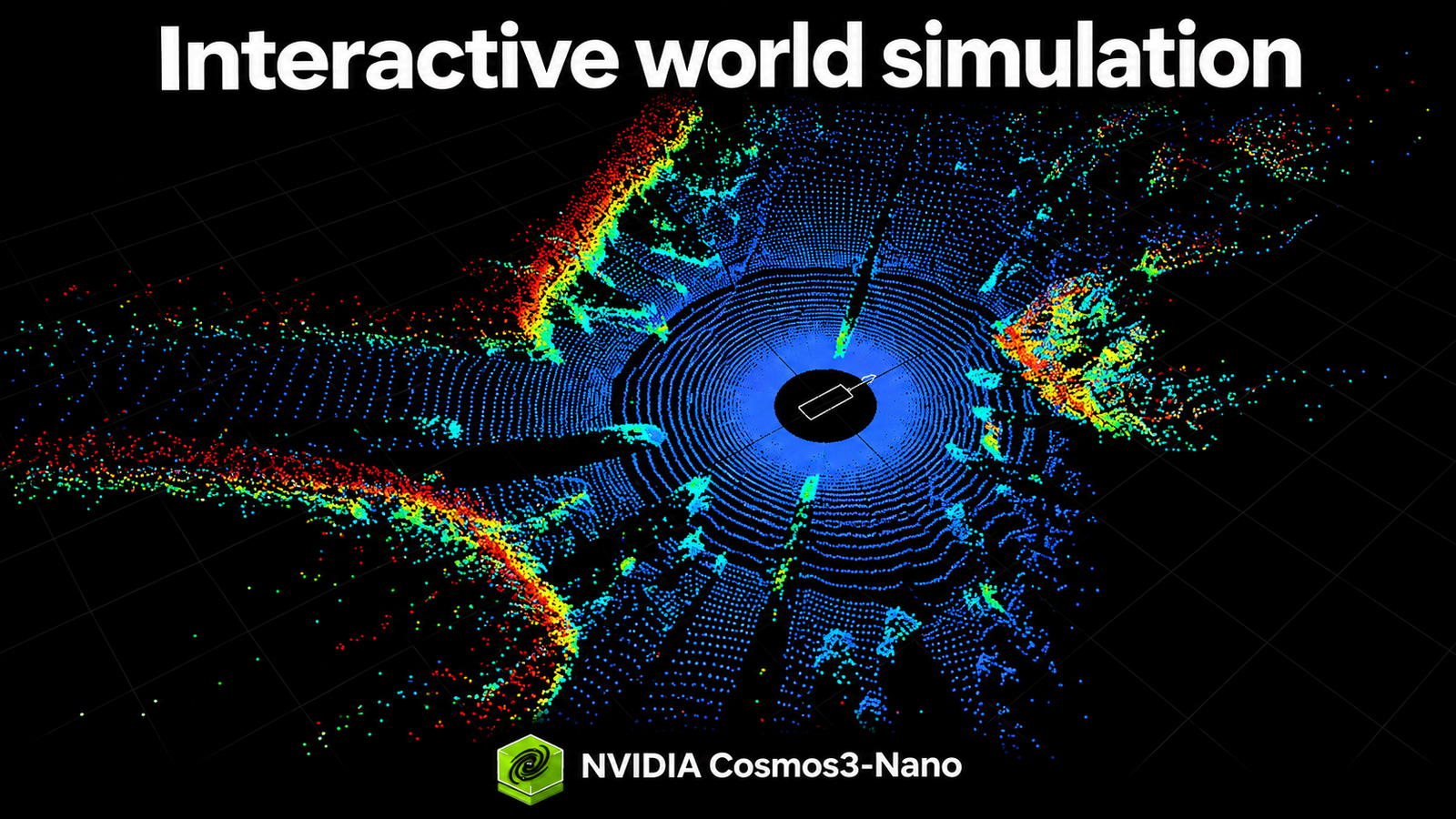
NVIDIA Cosmos world model development platform adds four new open-weight checkpoints to its Cosmos 3 model family for generating interactive world simulation and multi-sensor multi-view driving scenes:
All four models are post-trained examples of Cosmos 3 Nano and have 16B trainable parameters. The models use OpenMDW1.1, permitting commercial and non-commercial use under its terms.
Download the checkpoints · Read the technical report . Watch the demos
🦾 Robotics needs environments that can answer this across changing scenes and viewpoints. These checkpoints offer complementary ways to build them: Sim-Bimanual predicts visual consequences from actions, while Sim-Transfer turns a physics simulator’s controls into generated observations.
🚦 For autonomous driving, appearance and geometry must agree. Synchronized camera and LiDAR generation connects visual observations with 3D sensing. Scene and traffic-signal controls let researchers vary road layouts and signal states, then study how a driving policy responds.
🔄 Each observation can shape the next action. Streaming generation connects video prediction to ongoing interaction, giving world-model researchers a way to explore how actions and observations unfold together.
🌐 An open foundation for others to build on. NVIDIA’s vision is to help researchers and developers create richer, more responsive simulated worlds. Open weights and post-training recipes provide a shared starting point for adapting models, comparing methods, and contributing improvements. These problems remain hard: the work ahead is to measure where the models faithfully support policy learning and evaluation, understand their limits, and improve where they fall short.
Source link