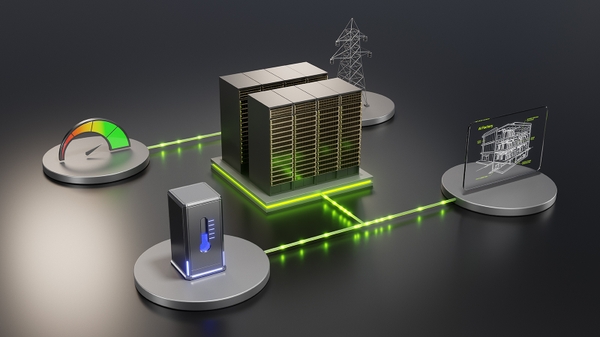
GTC Berlin—NVIDIA today announced that Europe’s leading ecosystem partners are adopting the NVIDIA DSX™ AI Factory Platform to build AI factories that minimize water consumption for cooling and use less power for the same AI output. The platform also helps partners bring new capacity online faster and adapt workload power consumption to support grid reliability.
NVIDIA DSX is a full-stack AI factory reference architecture, co-innovated with the world’s leading infrastructure companies. Compute, networking, storage, software, power and cooling are codesigned as one system — optimized from design to operation.
AI clouds and leading design, construction, energy and cooling providers are using DSX to build and operate infrastructure serving Europe’s enterprises, developers and governments.
“Europe’s technology leadership depends on how efficiently we turn power and infrastructure into intelligence,” said Warren Barkley, vice president of DSX product management at NVIDIA. “NVIDIA DSX brings together the technologies and ecosystem expertise operators need to build responsibly, operate efficiently at scale and bring intelligence to the market faster.”
The NVIDIA DSX platform includes DSX MaxLPS™ for dynamic power allocation, DSX Flex for coordinating workload power consumption with grid conditions, DSX Reference Design for validated infrastructure architectures, DSX Sim™ for simulation, DSX OS™ for infrastructure management and DSX Exchange™ for connecting computing and facility systems. These technologies help operators design, deploy and run AI factories that save valuable resources.
NVIDIA DSX Rethinks Cooling Conventional cooling towers remove heat by evaporating water, requiring a continual supply of replacement water. NVIDIA DSX reference designs connect liquid-cooled computing with dry-cooler-based heat rejection that avoids evaporation: Cooling liquid absorbs heat from computing equipment and circulates in a closed loop, while outdoor dry coolers, similar to large radiators, release that heat into the air without evaporating water.
Source link