This article has been reviewed according to Science X's editorial process and policies. Editors have highlighted the following attributes while ensuring the content's credibility:
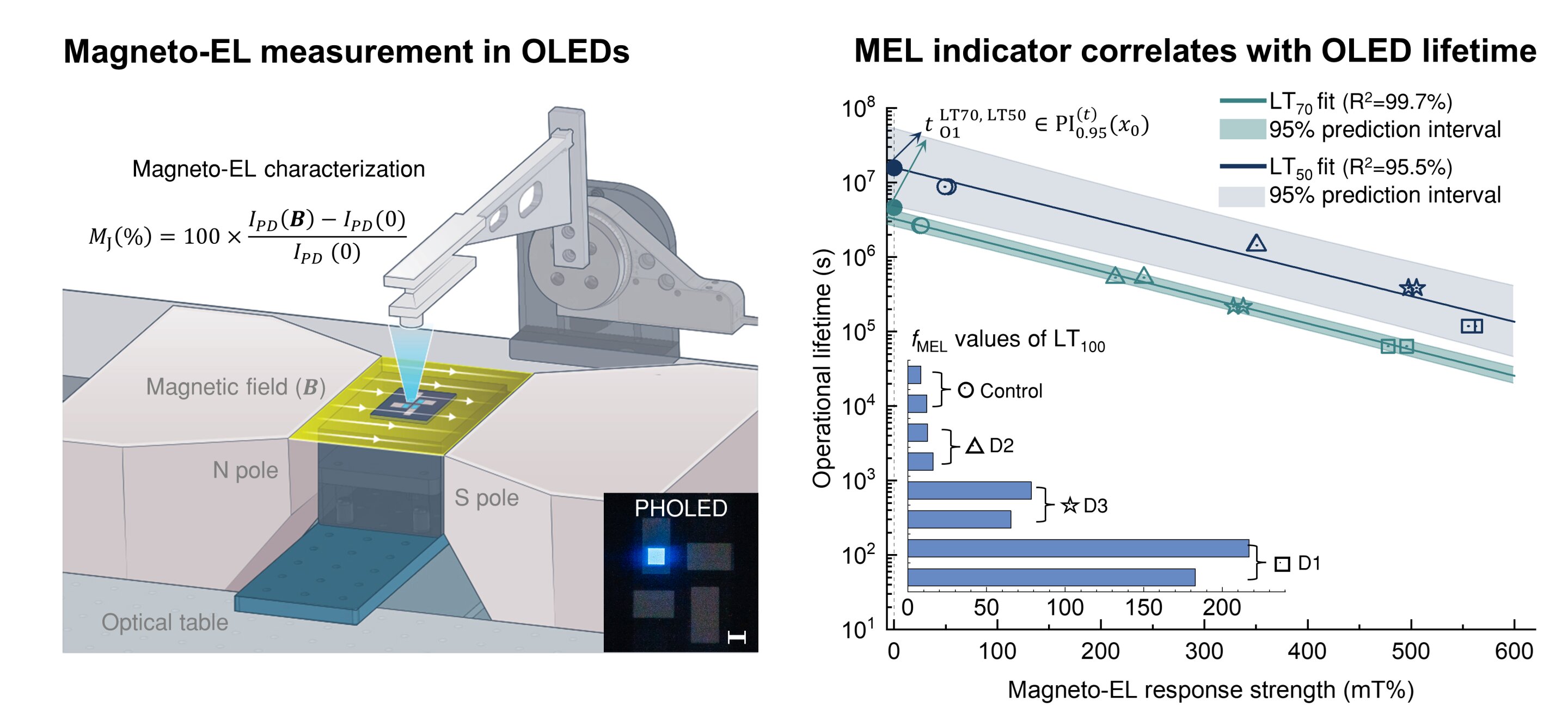
Could a magnetic field be used to identify in advance which OLEDs will keep smartphone and TV screens bright the longest? A KAIST research team has developed a technique that predicts OLED lifetime by analyzing small changes in brightness caused by a magnetic field. The technique reduces the need for long operating tests and is expected to support the development of longer-lasting displays.
A research team led by professor Seunghyup Yoo of the School of Electrical Engineering has developed a method that predicts the lifetime of blue phosphorescent OLEDs from changes in their brightness under a magnetic field.
The study was conducted jointly with professor Jang Hyuk Kwon's team at Kyung Hee University, professor Jae-Hyun Lee's team at Hanbat National University and researchers at ASTA Inc.
OLEDs are devices that emit light on their own when an electric current flows through them, and they are used in smartphone and TV screens. A screen produces a wide range of colors by combining red, green and blue light. The blue phosphorescent OLED examined in this study uses electrical energy efficiently to emit blue light. Achieving a long lifetime while maintaining high efficiency is a key challenge in its development.
Conventionally, determining how long an OLED will last has required operating it for tens to hundreds of hours while monitoring the decrease in brightness. This process takes a long time, and the device's performance also degrades during testing.
Source link