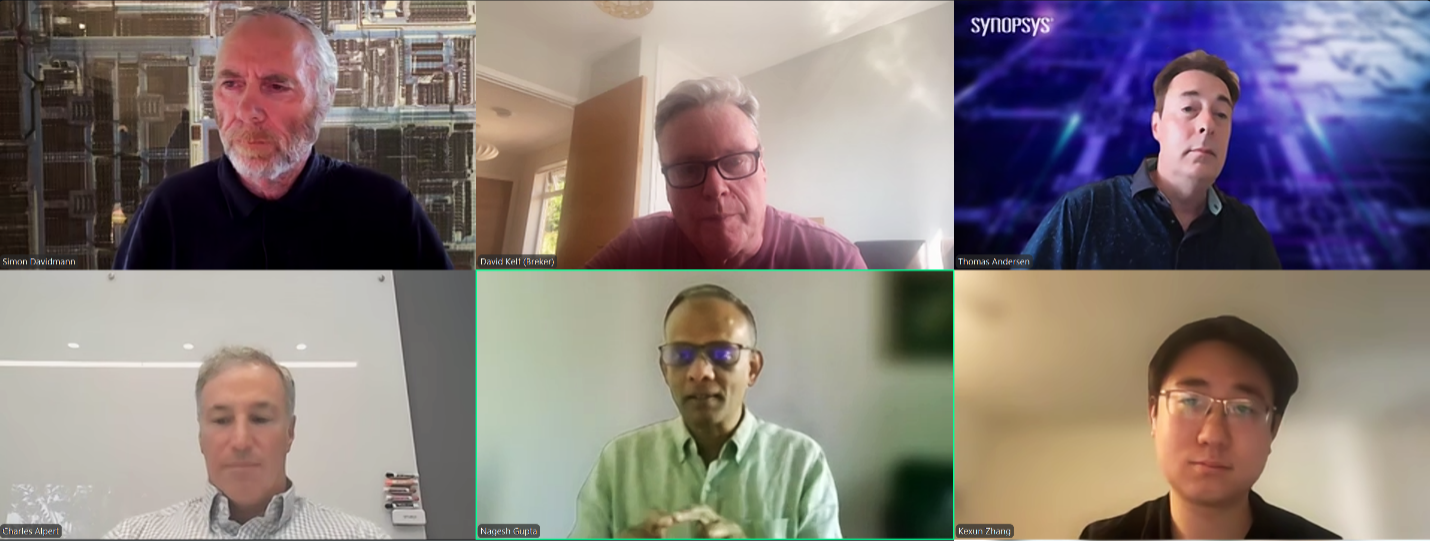
Experts at the Table: Semiconductor Engineering sat down to discuss what is happening with the latest college graduates in the face of AI adoption, with Chuck Alpert, fellow at Cadence; Thomas Andersen, vice president of AI and ML at Synopsys; Simon Davidmann, AI and EDA researcher at Southampton University; Nagesh Gupta, CEO of llmda.ai; Dave Kelf, CEO of Breker Verification Systems; and Kexun Zhang, Head of Research from ChipAgents. What follows are excerpts of that discussion. This is the first article in a three-part series.
Clockwise from top left: Southampton University’s Davidmann; Breker’s Kelf; Synopsys’ Andersen; ChipAgents’ Kexun; llmda’s Gupta; and Cadence’s Alpert.
SE: AI is disruptive to EDA, the semiconductor industry, and to their customers. One early indication is that computer science (CS) grads are struggling to find jobs. In the past, they were highly sought after. Today, they have moved to a higher unemployability rate than the general averages. What’s going on?
Gupta: From my observations, data science is much more significantly affected compared to computer science. I’ve been looking for computer science grads, but from good universities. There are not that many good CS grads available. It’s more of the data science that seems to be affected.
Alpert : We know that the vibe-coding tools — Cursor, Claude Code, GitHub Copilot — are improving the productivity of computer scientists, and so it’s natural there will be a hiring slowdown. Companies are spending a lot of money on Claude and OpenAI for these things, and they don’t want to hire quite so many engineers at quite the same rate.
Source link