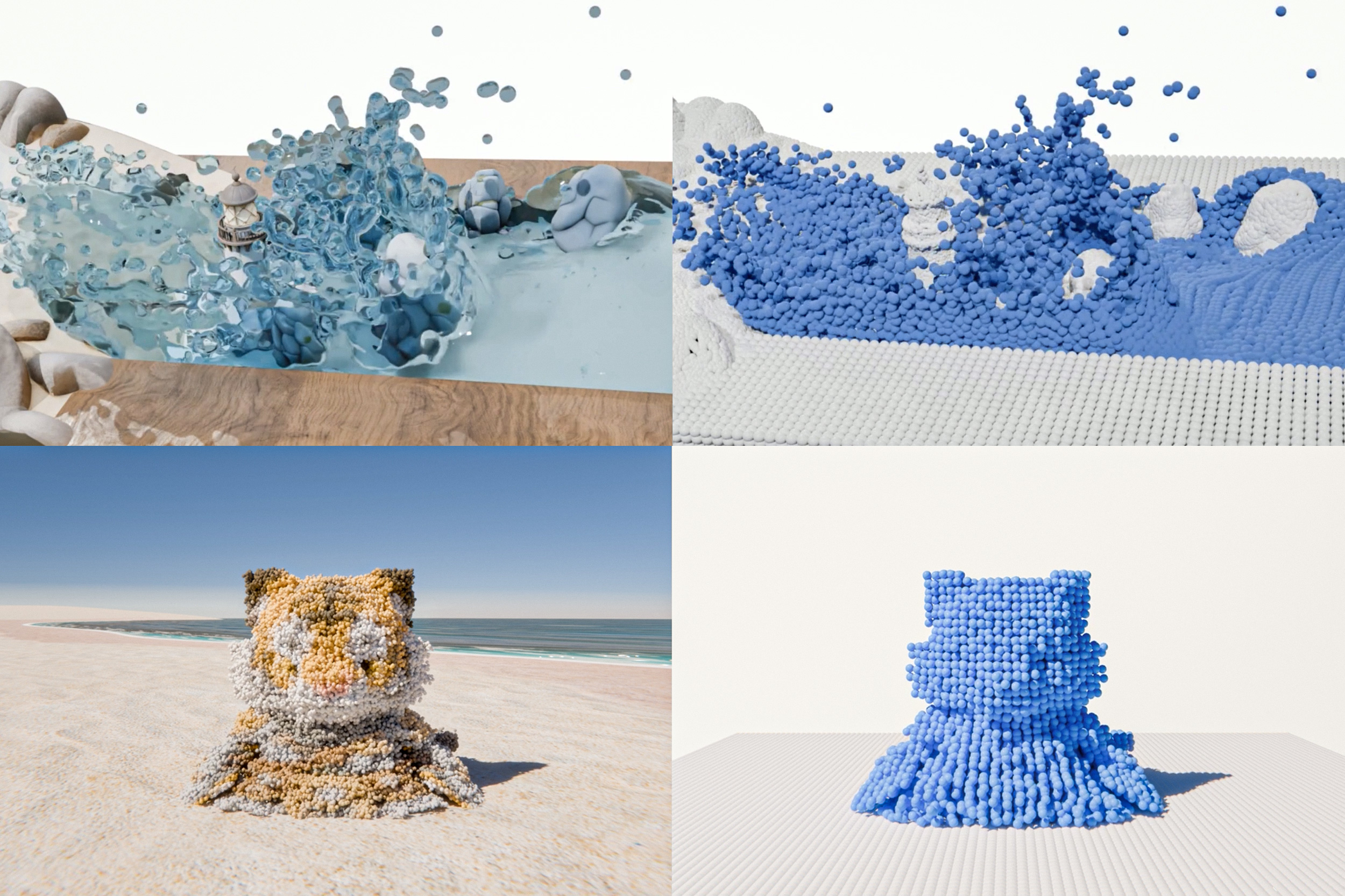
Today, a scientist who wants to simulate a physical process must pick the right tool for that one job, such as a solver built for flowing water or another designed to model the way a protein folds. Each one is hand-coded around the specific equations that dictate how that process behaves.
Researchers at MIT, the University of British Columbia (UBC), and elsewhere have now replaced that patchwork with a single deep-learning system, called WorldParticle, that could help engineers model different physical phenomena, from sliding sand to folding proteins, with one unified artificial intelligence architecture.
Scientists and engineers could use this system to model processes that typically require separate simulators, such as a fluid sloshing against a deformable solid. This could offer a faster, more accurate way to simulate how sloshing oil might impact an elastic valve in a storage tank, for instance. It could also help engineers study where and how granular materials, like sand or soil, could move when a soft robot touches them.
The system represents every material it simulates, from a dune of sand to a protein molecule, as tiny particles and predicts where those particles will move one step at a time. Because it learns the underlying dynamics rather than being programmed with an equation, the model can adapt to materials, forces, and environments it never encountered during training.
In the long term, the researchers hope this work helps scientists discover new materials and explore physical processes they would be unable to effectively study with existing simulation methods.
Source link