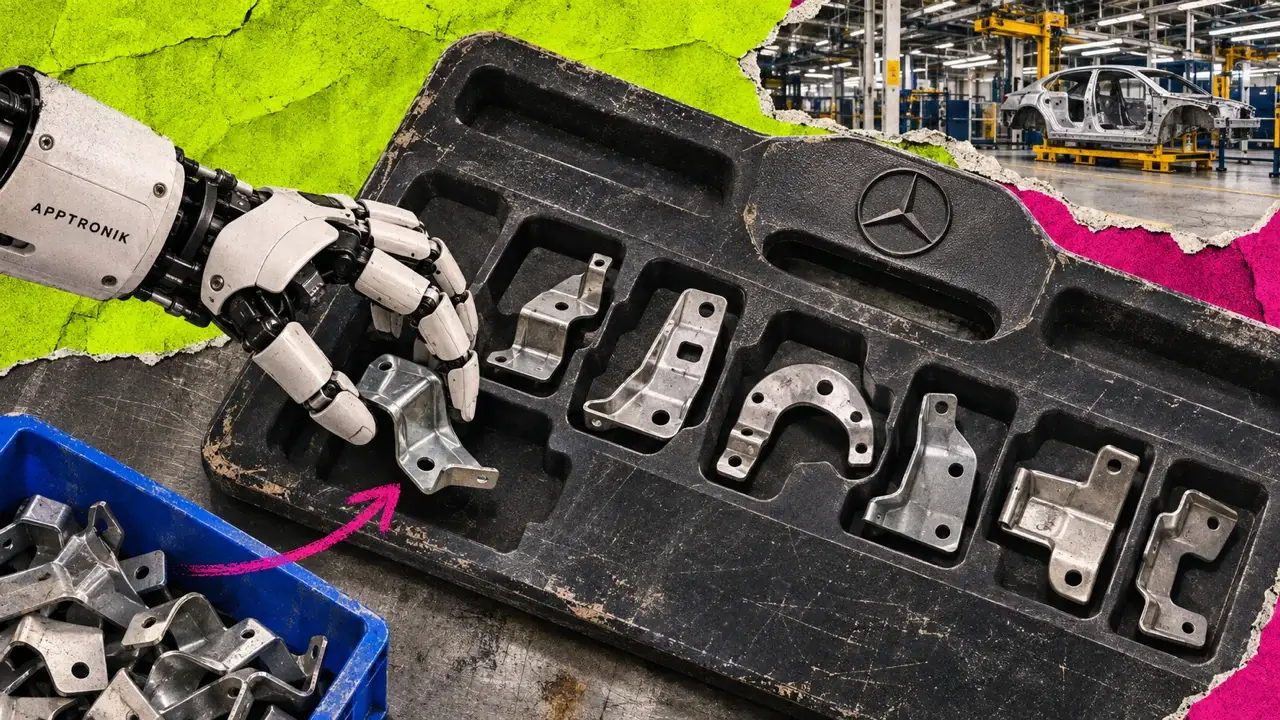
Researchers introduce World In-Context Learning (WICL) and RoboScript, achieving 83.4% success in robotic tasks with a single demonstration.
Researchers from Huazhong University of Science and Technology and ArcheOne AI have unveiled a groundbreaking approach to robotic manipulation called World In-Context Learning (WICL). Published on November 11, 2026, on arXiv, the study introduces RoboScript, an open-source framework that achieves state-of-the-art performance in robotic tasks using a single demonstration without gradient updates.
Traditional trained action policies encode manipulation skills into network weights, limiting their adaptability to new environments. In contrast, WICL decouples learning from weights by leveraging in-context learning. A frozen foundation model starts from a single demonstration, rehearses the task in a simulated environment, and stores the learned knowledge as a Task Memory. This memory is then deployed in new, unseen scenes, ensuring adaptability across diverse visual distributions.
RoboScript was validated on RoboTwin 2.0, a benchmark of 50 bimanual manipulation tasks. The framework achieved an 83.4% mean success rate across clean and randomized settings, outperforming the strongest trained action policy by over 20 percentage points. Notably, this success was achieved with just one demonstration per task, compared to 50 demonstrations required by traditional methods. The system's performance remained consistent across randomized scenes, with success rates dropping minimally from 83.6% to 83.2%.
RoboScript's modular infrastructure enables robots to learn tasks in context rather than weights. Key features include:
0 on GitHub. The repository, created on November 5, 2026, has already garnered community interest, with 34 stars and no open issues as of the publication date.
Source link