DeepMind reports 96% success in a parts-sorting pilot on Mercedes-Benz production lines in Germany and Hungary. Human-intervention rates remain undisclosed.
Google DeepMind says robot maker Apptronik's Apollo 2 humanoids achieved a 96% success rate sorting automotive parts on active Mercedes-Benz production lines, using AI to handle preparation work that feeds vehicle assembly.
The company disclosed the proof of concept on Nov. 10, identifying sites in Kecskemét, Hungary, and Sindelfingen, Germany. The work provides a specific test for its Gemini Robotics 2.5 model: arranging the components needed by the people building cars.
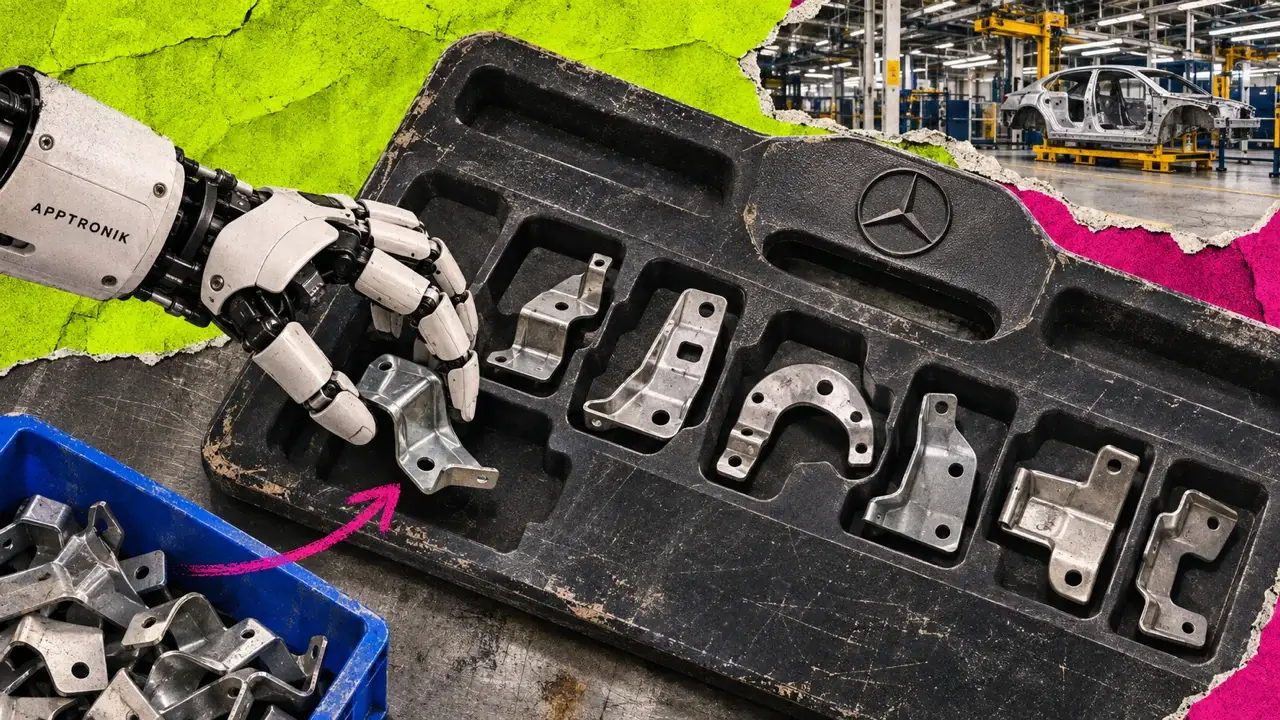
The task was automotive kitting, which involves taking parts from bulk bins and organizing them in the order needed for each vehicle. DeepMind's example involved picking up metal brackets and placing them into sequencing containers. That ties the demonstration to a defined step in preparing an assembly line's supplies. The trays are meant to match the parts needed for each vehicle, so getting the sequence right is part of the task. The robot has to organize the components as well as move them.
Apollo 2 prepared parts in vehicle order in DeepMind's Mercedes-Benz proof of concept.
A defined preparation task is working in a pilot; the sustained operating burden remains unquantified.
Company-reported proof of concept. Evaluation duration and uptime were not disclosed. The diagram is schematic and does not depict Apollo 2's actual hardware.
Qualitative process schematic based on DeepMind's description, disclosed November 10, 2026. Bracket shapes and their count are illustrative, not trial observations. The 96% is the reported figure, without inferred denominator or derived arithmetic.
Source link