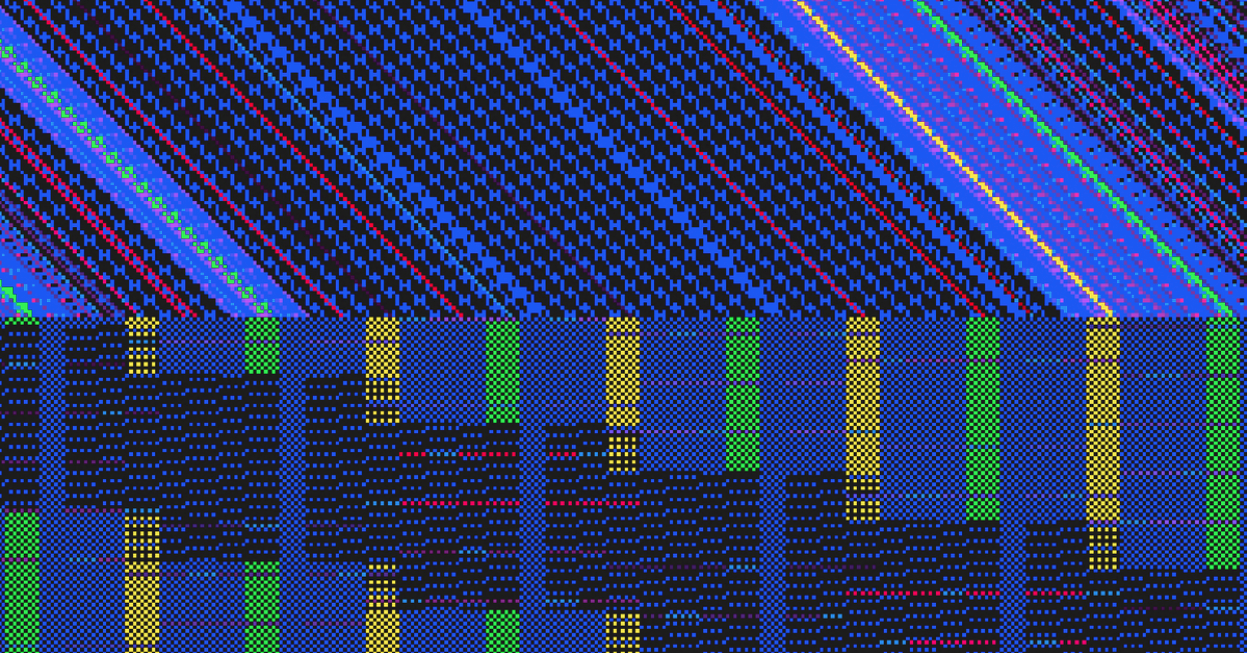
A mosaic is an artwork assembled from fragments. From ancient Roman floors to Byzantine churches, artists have used pieces of stone, glass, and ceramic to construct images that have endured for centuries.
For the generative artist known as BitArt, those fragments are satoshis (or sats), the smallest units of bitcoin.
In Mosaic, a continuously evolving artwork developed through the Bitcoin Art Society (BAS), the numerical properties of satoshis are translated into color and spatial coordinates. Each contribution adds to an expanding composition of pixels resembling digital textiles, early computer graphics, or abstract paintings.
Rather than illustrating bitcoin through familiar iconography, Mosaic treats the network itself as artistic material. Satoshi positions and unspent transaction outputs (UTXOs) become inputs for a rule-based system that determines the artwork’s appearance. BitArt begins with bitcoin’s underlying data and allows an image to emerge.
The approach recalls conceptual artist Sol LeWitt’s proposition that an artwork can exist as a set of instructions rather than a singular handcrafted object. Generative artists such as Vera Molnár and Manfred Mohr similarly explored how mathematical systems and computational procedures could produce visual compositions. Mosaic extends this tradition into an economic network shaped by transactions and human decisions.
The scale is extraordinary. According to BitArt, Mosaic now contains more than 127 million tiles and one billion layers. Viewing every layer at a rate of one per second would take over 30 years.
The project has also expanded into sound. Its musical component draws from the same satoshi data that generates the imagery, translating numerical values into an evolving score.
Source link