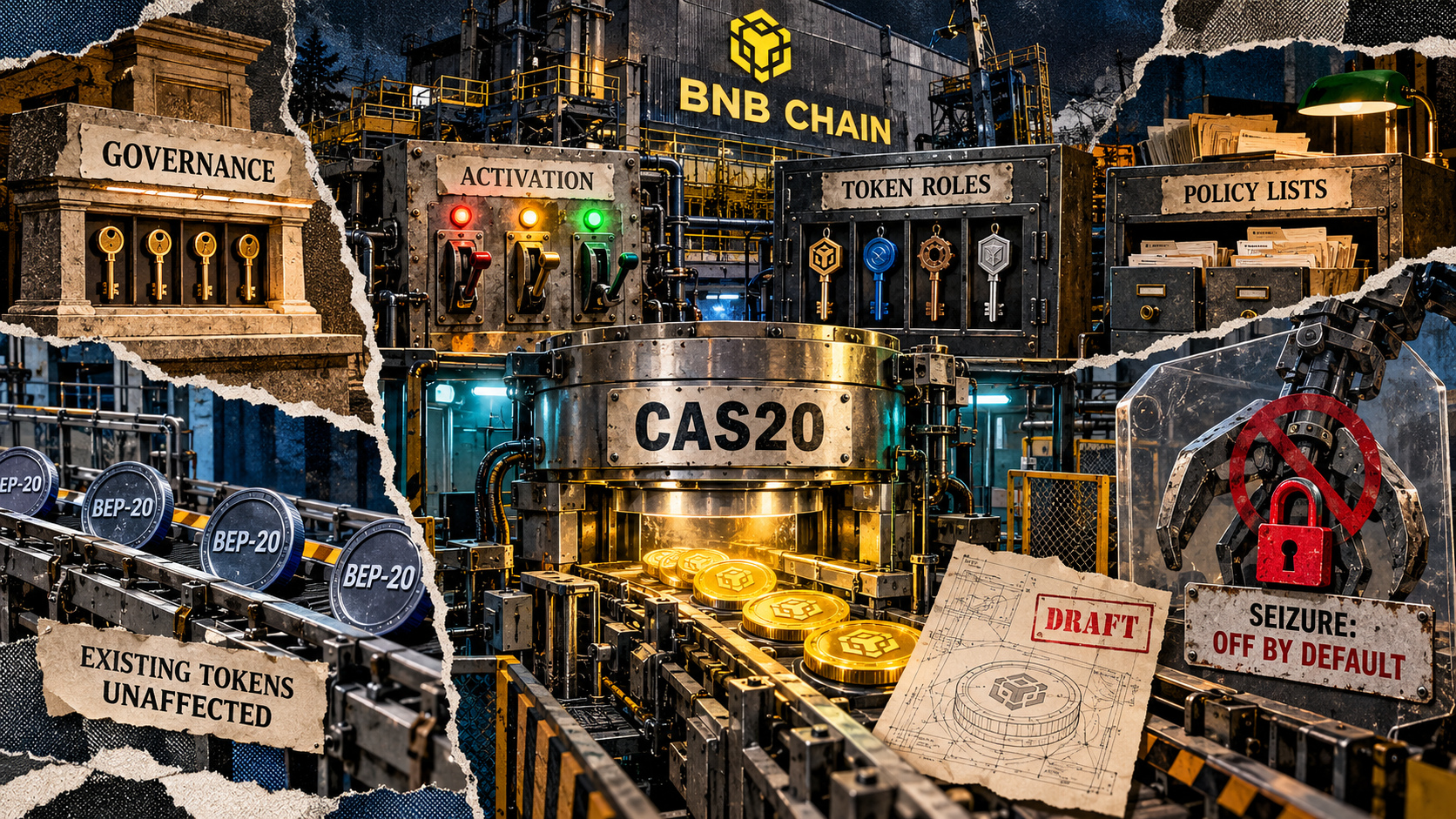
Jenner’s testnet release separates CAS20 creation from issuer powers, while shared compliance lists would depend on another network switch.
BNB Chain’s Jenner testnet release advances a native-asset design that would give a governance-appointed administrator control over when new stablecoins and tokenized assets can be created.
Issuers could have the code available on the network and still need a separate feature switch opened before launching a CAS20 token.
The Oct. 16 v1.8.1 release schedules Jenner for BNB Smart Chain’s Chapel testnet on Oct. 29 at 02:30 UTC. An earlier announcement gives late-November mainnet guidance, with the exact time still unannounced.
The proposed BEP-702 standard remains labeled Draft and covers the new CAS20 token family, while existing BEP-20 tokens would remain unaffected. Its architecture separates three questions: whether the network admits a feature, who can exercise a token’s powers, and which holders those powers may affect.
CAS20 would put common token behavior into native chain logic, implemented as stateful precompiles. The same design gives network governance a role in making the infrastructure available, alongside the issuer’s control over the asset itself.
Under BEP-702, chain governance appoints the activation administrator through GovHub, BSC’s governance forwarding contract. The administrator then makes separate calls to activate or deactivate features.
The release’s activation implementation enforces that division. Only GovHub can change the administrator, and only the stored, nonzero administrator can operate the switches.
The design provides separate switches for creating Asset-variant tokens, creating Stablecoin-variant tokens, and writing to the shared policy registry.
Once a variant is enabled, the factory’s creation path does not contain an individual-issuer approval list.
Source link