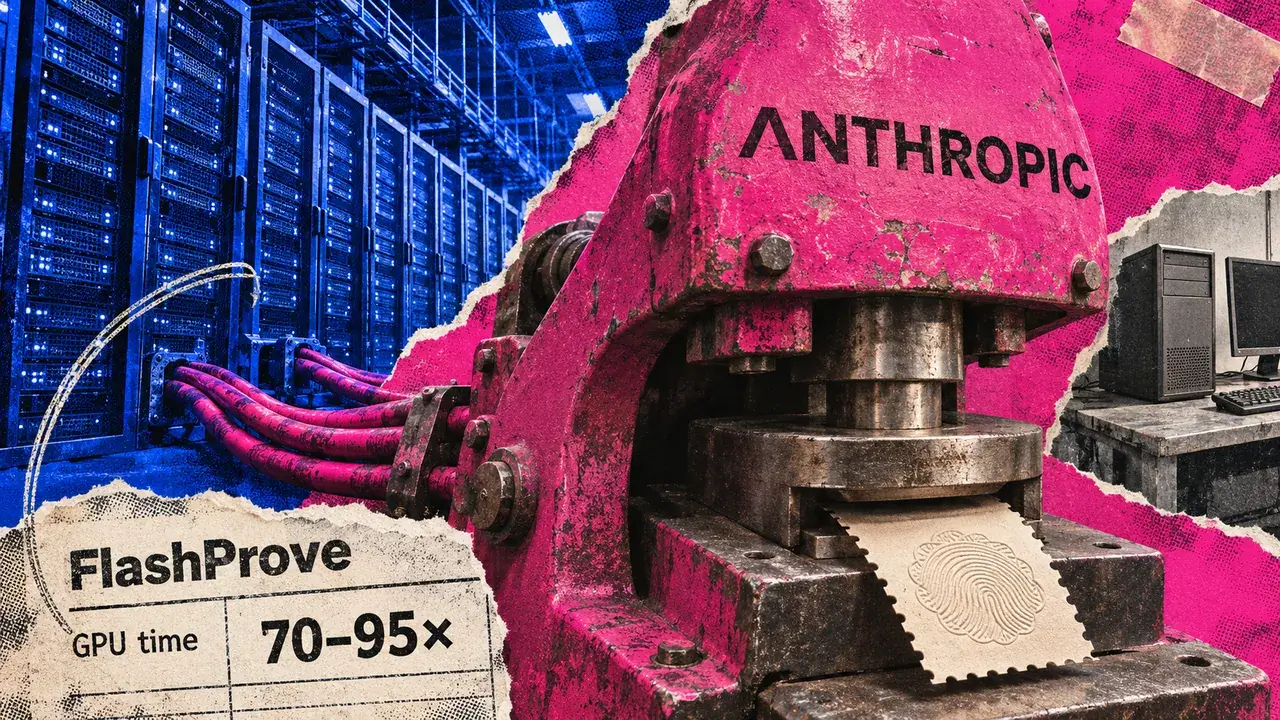
FlashProve could help verify model computation, but its benchmark takes roughly 70 to 95 times the GPU work of ordinary inference.
When you pay for access to a named AI model, identifying it from its answers alone remains unreliable. A convincing reply can show that a service works, while leaving a more basic purchase question unresolved: did the model you selected actually do the work?
Anthropic's FlashProve research release, published Nov. 2, offers a way to check model computation without exposing the model's private weights. The catch is the work required to produce that assurance: roughly 70 to 95 times the GPU time of ordinary inference in the company's benchmark.
That makes FlashProve a potential safeguard for buyers using third-party AI services, with substantial distance still to travel before routine use. The demonstration uses Meta's Llama 4 Maverick, not a verification feature being switched on for Claude customers.
The process begins before a response is checked. A provider publishes a cryptographic commitment to its model weights, the numerical parameters that determine how the model computes an answer. Think of it as a fingerprint that fixes which weights subsequent proofs must match, while keeping those weights hidden.
The provider then produces a proof that the committed model, given the specified input, produces the checked output. A verifier can check that proof without downloading the weights or running the model again.
For readers familiar with blockchain, this uses the same broad family of zero-knowledge proof techniques used to verify computation in Ethereum layer-2 systems.
Source link