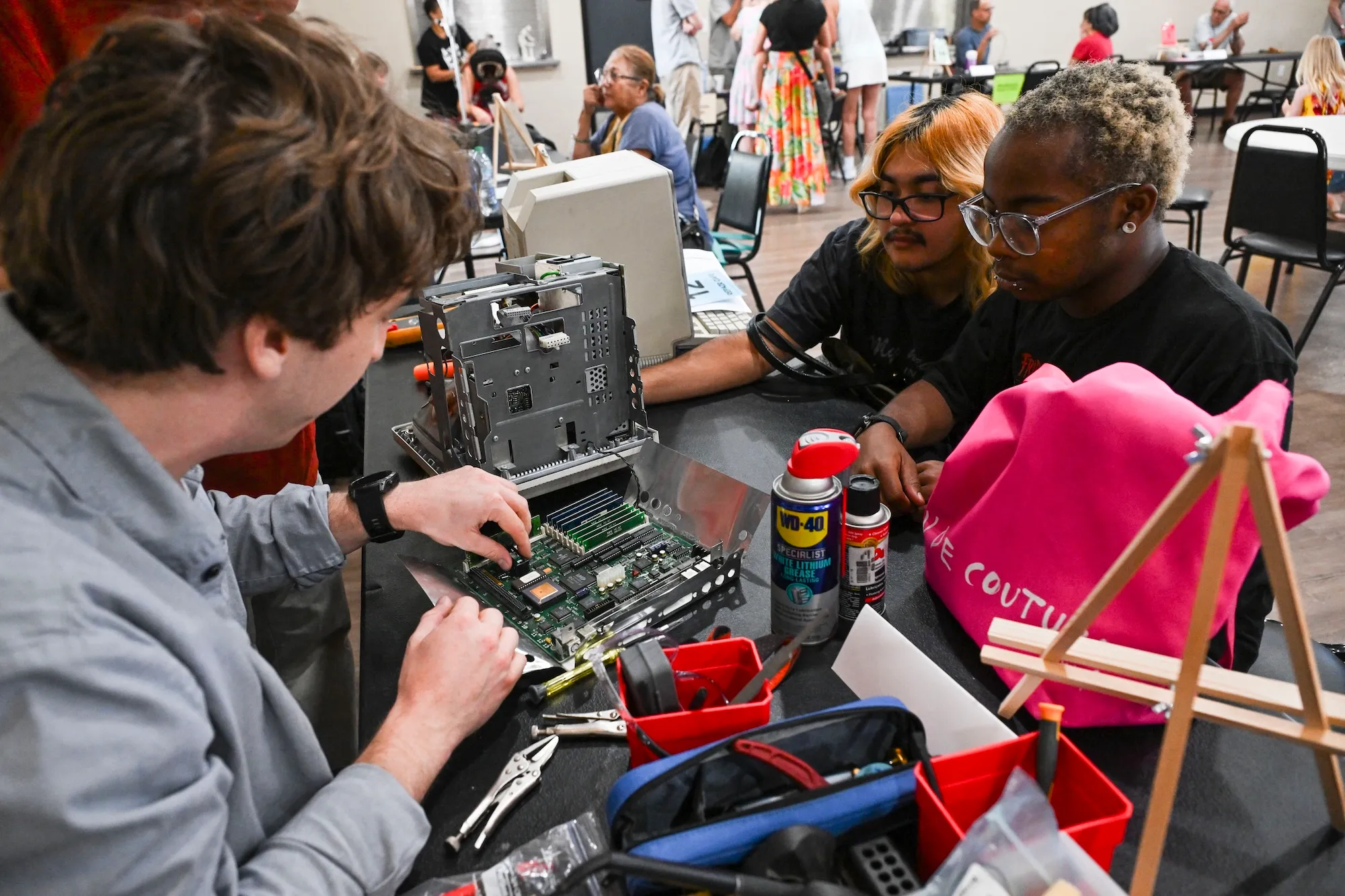
On an unusually cool and rainy Saturday morning in Decatur, Georgia, dozens of people filed into a warehouse at the back of a church parking lot, their arms full of what a less hopeful group might call junk. Some carried broken lamps, glitching electronics, or cracked furniture. Others walked in with toolboxes, multimeters for testing electric currents, and cans of WD-40. Beneath extension cords dangling from the rafters, they sorted themselves into smaller groups: the volunteer electricians, tailors, luthiers, carpenters, and at least one cutler (knife sharpener), commandeering nearby worktables and passersby as needed.
That’s how Lilly Pettus ended up shoulder to shoulder with three strangers, their hands all pressing together the pieces of her family’s cracked dining room chair as wood glue hardened and a volunteer tightened a clamp.
“This is so interesting,” a giddy Pettus said, inspecting for the first time the joints, one of them broken, that held together the chair she’d owned for decades. “You never even know how furniture is put together.”
This is Decatur’s semi-regular repair café, one of a few hundred meetings like it across the United States. More Americans than ever are turning to these community gatherings to fix what they already own, resisting the influence of companies that sell everything from hiking boots to smartphones and hot water boilers and that push for replacement over repair. One consequence of this throwaway economy is an increase in greenhouse gas emissions from manufacturing that threatens to intensify climate change.
Yet, organizers and volunteers consider repair cafés to be more than a relatively small climate solution.
Source link