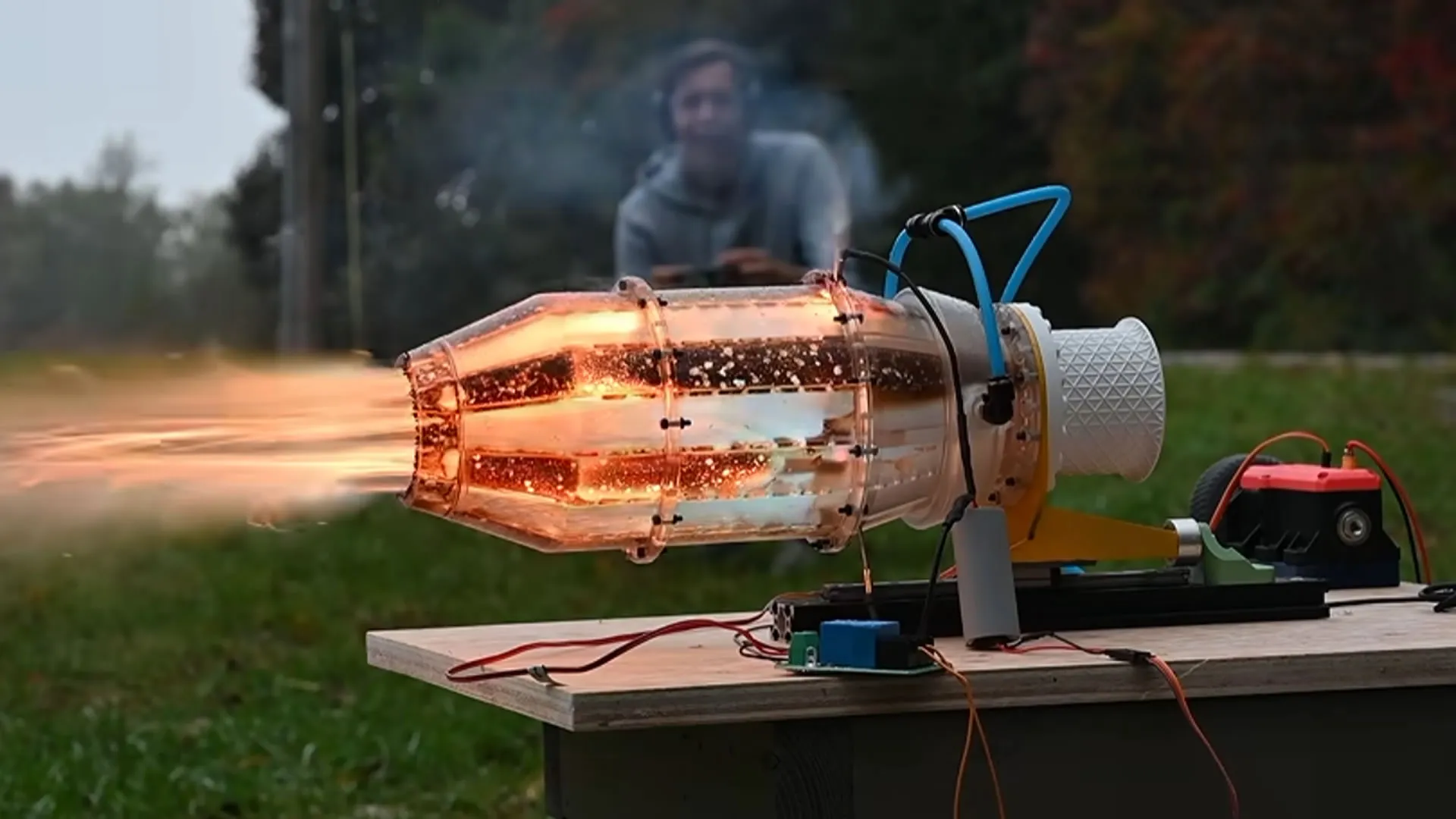
A YouTuber has created a functional homemade afterburner using mostly 3D-printed parts. He essentially took an electrically powered ducted fan (EDF), injected propane into the exhaust, and produced additional thrust.
In case you are unaware, an EDF is basically a high-speed electric fan inside a tube. These are commonly used in things like model aircraft to imitate jet engines.
Unlike conventional jet engines, EDFs don’t burn fuel. Instead, an electric motor drives the fan, accelerating air backward to produce thrust. Its electric motor drives the fan, which accelerates air backward to produce forward thrust.
For his latest project, YouTuber Michael Rechtin decided to add a combustion chamber behind it. The process was fairly straightforward, at least on paper.
The fan should accelerate air through the duct as normal. After that, propane can be injected into the moving air downstream of the fan.
Some form of ignition source will then ignite the propane. This heats the air dramatically, expanding it and exhausting the hot gas at a much higher velocity than normal.
In theory, much like an afterburner, this should increase the thrust produced by the “engine.” The physics is sound, but to make it viable, the “cost” of fuel must produce sufficient additional thrust to make it worthwhile.
Jet engines and propulsion are fundamentally about momentum. The faster you throw a given mass of air backward, the more forward thrust you can generate.
When the propane burns, it adds thermal energy to the airflow. If the duct and nozzle convert enough of that energy into additional exhaust velocity, thrust increases.
Source link