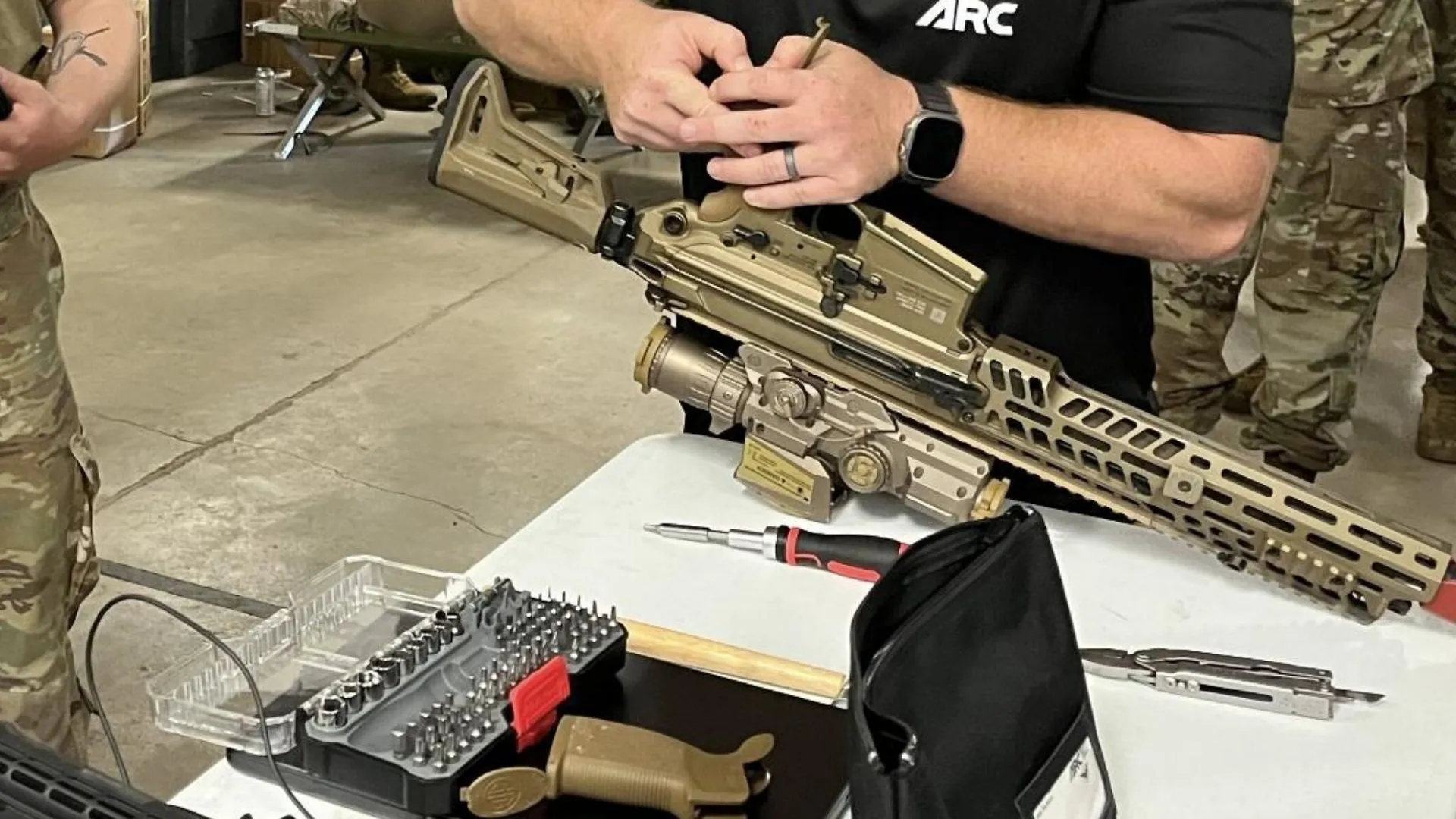
The U.S. Army has awarded Armaments Research Company (ARC) a $4.7 million contract to integrate AI-enabled weapon sensors into live collective training, potentially giving commanders and trainers a much more detailed picture of how soldiers employ their weapons during exercises.
The 12-month Other Transaction Agreement (OTA) supports the Army’s Capability Program Executive Simulation, Training, Test and Threat (CPE ST3), which develops and fields technologies for military simulation, testing and training.
The effort will connect ARC’s AI-enabled weapon sensors (AEWS) to the Army’s live training environment and tactical network, aiming the turn weapon employment into measurable, real-time data.
ARC said in its announcement that Army tactical units originated the requirement through operational validation. The company says the current training environment can leave commanders and Observer Controller/Trainers with relatively limited objective data about how units actually fight.
Under the new effort, AEWS will collect information during large-scale collective training and feed it into the Army’s training architecture. The resulting data is intended to support common operating pictures and after-action reviews, allowing trainers to examine what happened during an exercise in greater detail.
ARC describes AEWS as a weapon-mounted sensing system that combines embedded sensors, data processing and AI-enabled analytics. The company says its broader platform can turn individual weapons into networked sensors, with applications including training optimization, situational awareness, predictive logistics and predictive maintenance.
For the Army, the new contract specifically focuses on using the technology in live collective training rather than simply monitoring an individual weapon.
The objective is to make weapon employment measurable, rather than relying primarily on observations made during or after an exercise.