Age-related macular degeneration (AMD) affects more than 5 million people around the world. And until now, no treatment could restore their vision. The Prima system, which was approved in Europe in July and is awaiting FDA clearance in the US, changes that. It combines a retinal implant with camera-equipped eyeglasses to improve sight in patients who develop a blind spot in the middle of their vision due to advanced AMD. After training sessions, more than 80% of recipients were able to read, do crosswords, and use their phones.
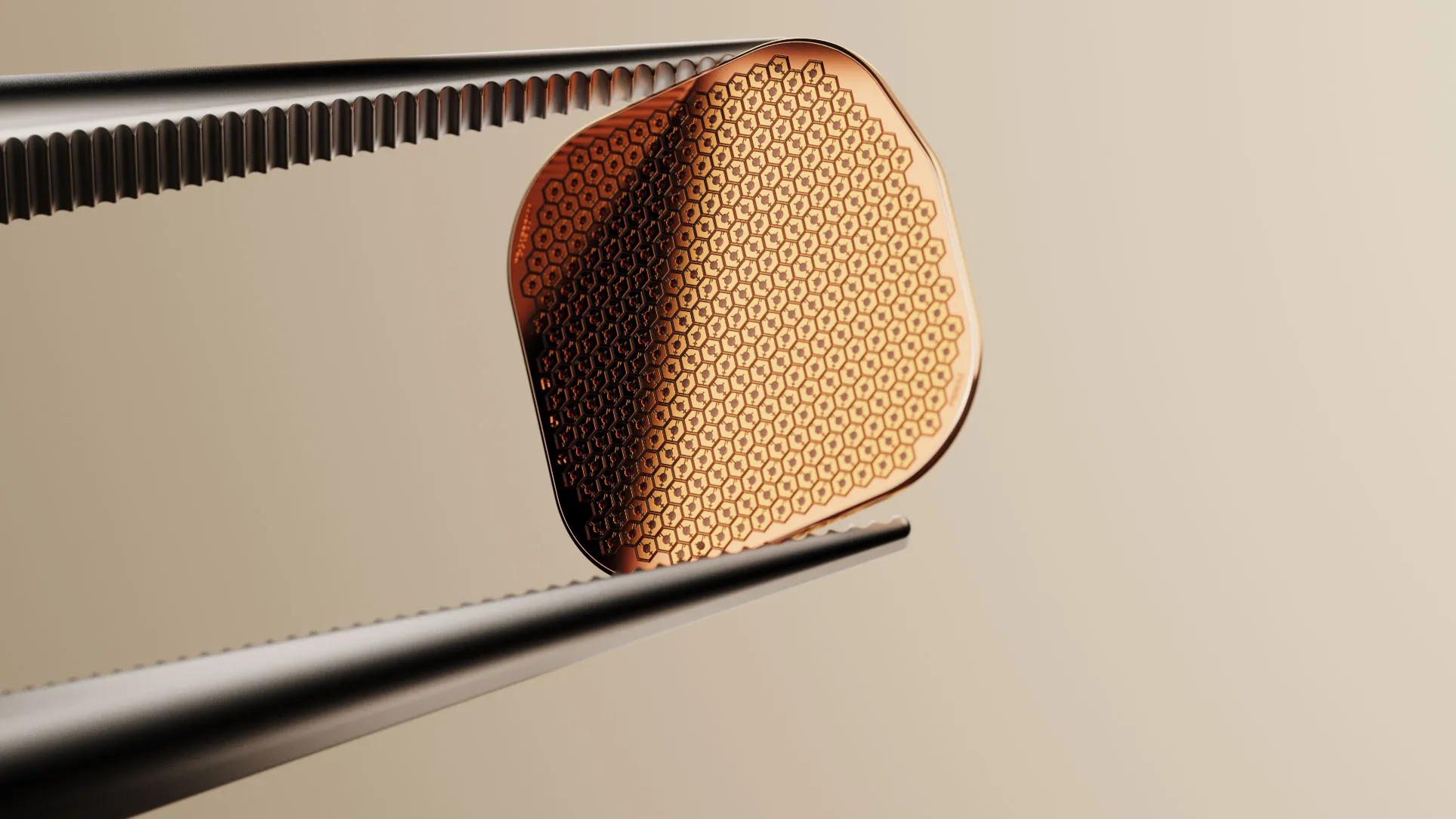
Developed by the California-based Science Corporation, the system takes advantage of the fact that AMD doesn’t damage all retinal circuitry; only photoreceptors—the cells that convert light into an electrical signal—die off. Prima’s implant mimics those cells and transmits visual information directly to healthy eye circuitry and on to the brain. “We’re leveraging all of the body’s own natural functions to process and transmit the information,” says Frank Brodie, an ophthalmologist at the University of California, San Francisco, and medical director for Prima.
Glasses outfitted with a miniature front-facing camera capture what someone is seeing in real time. The video feed is roughly five megapixels running at 30 frames per second, which is similar to TV. The raw video is transmitted to a connected processor via a fiber-optic cable.
A small, handheld processor, which can be set on a table or tucked in a pocket, converts the video feed into infrared light signals that route back to the glasses. The device also includes physical buttons that let the wearer adjust contrast, brightness, and zoom.
Source link