Scientists have developed a system that uses structure-borne sound sensors and machine learning to measure rainfall without moving parts.
The technology could complement conventional rain gauges. The system achieved an average error of 1.88 millimeters per hour,
Scientists have developed a new artificial intelligence (AI)-powered rainfall monitoring system that can estimate light rainfall with an average error of just 1.88 millimeters (mm) per hour.
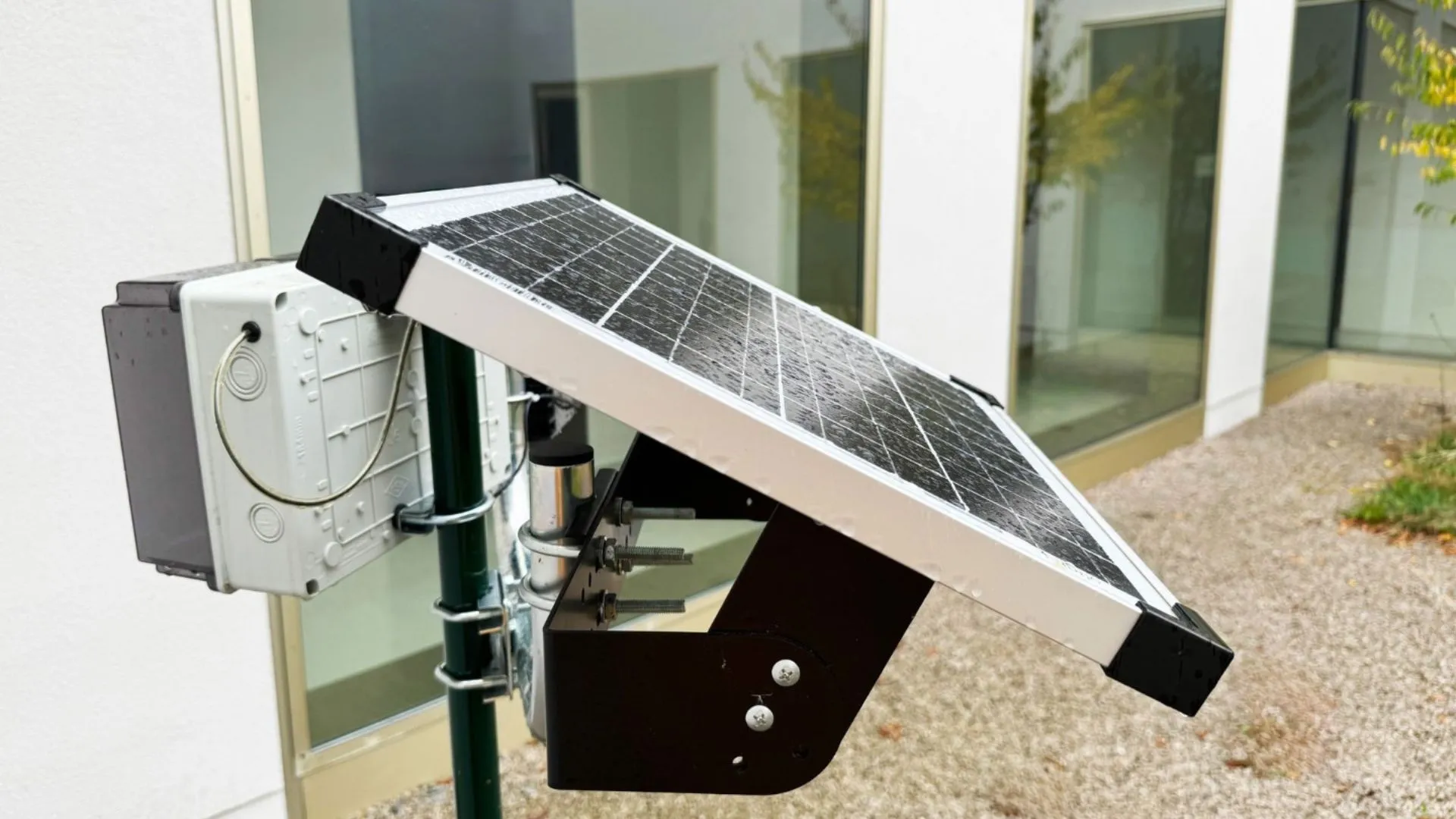
The new method, developed by researchers at Germany’s Fraunhofer Institute for Digital Media Technology (IDMT) and Pan Acoustics GmbH, analyzes the tiny vibrations produced when raindrops strike solar panels. It offers a low-maintenance alternative for expanding weather monitoring networks.
The system uses structure-borne sound sensors and machine learning to measure rainfall without moving parts. The technology could complement conventional rain gauges by creating dense networks of inexpensive measurement points that capture highly localized rainfall.
The researchers demonstrated the approach through the recently completed lokalRAIN project, testing the system in both laboratory experiments and outdoor installations. They are now seeking industry partners for additional pilot deployments to evaluate the technology under a wider range of operating conditions.
“We have proven the feasibility of our approach for light rain,” said Jakob Bergner, the project’s scientific director at Fraunhofer IDMT. “Now we want to collect further data for the less frequent heavy rain events and optimize the procedure for different operating conditions.”
The system attaches structure-borne sound sensors to photovoltaic (PV) modules. Every raindrop that hits the panel generates microscopic vibrations, creating unique acoustic signatures that vary with rainfall intensity.
Source link