Imagine a future where discarded coffee grounds could be found in buildings. It seems like something from a children’s storybook.
But, truth be told, an interdisciplinary team at the Royal Melbourne Institute of Technology (RMIT) in Australia has shown that fiction is not far from reality.
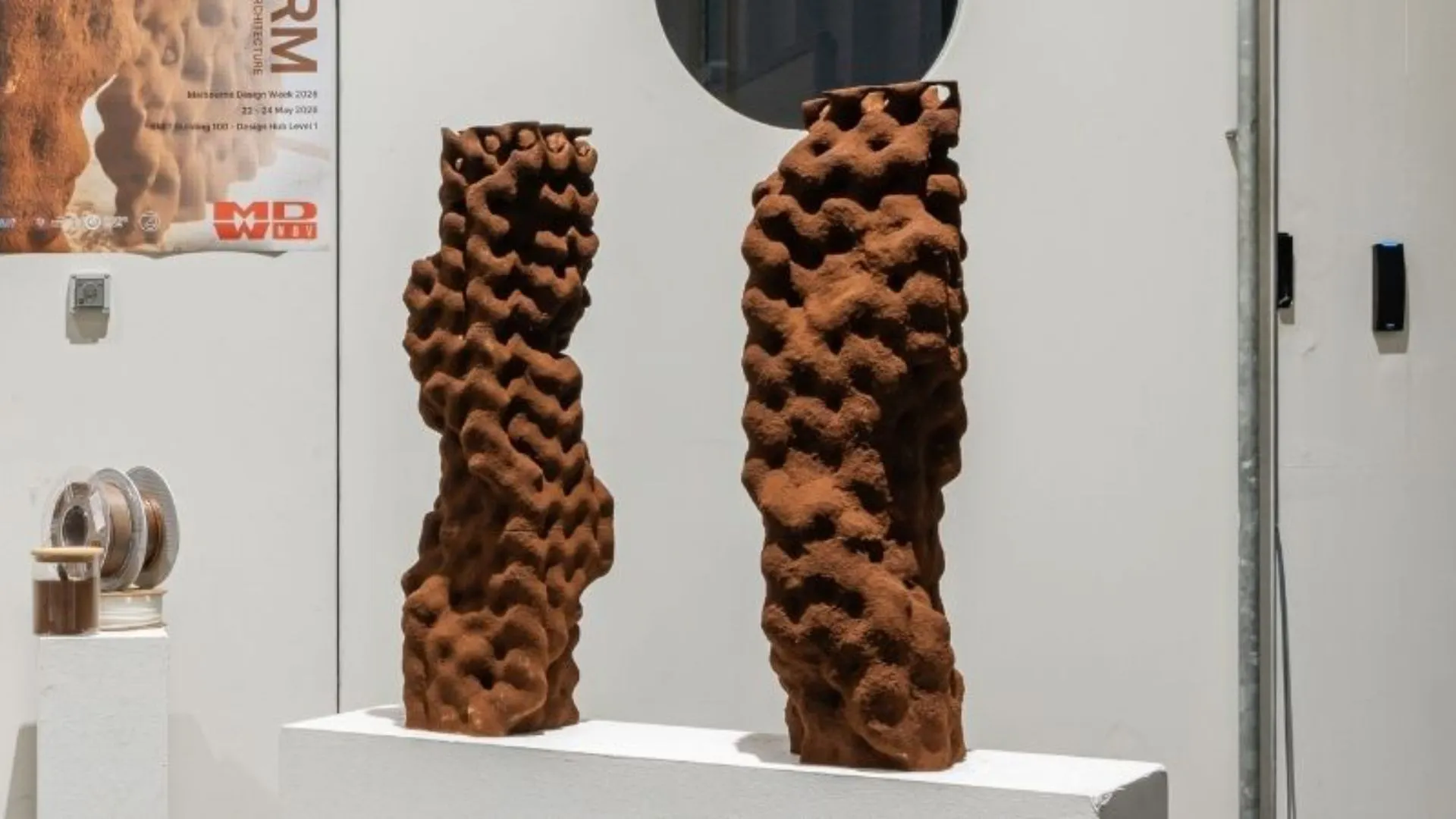
At Melbourne Design Week, the team showcased architectural designs created from locally sourced discarded coffee grounds.
A team led by Professor Baohua Jia from RMIT’s School of Science and Nic Bao from the School of Architecture and Urban Design has developed a biodegradable 3D-printing filament that uses coffee waste as its base raw material.
By turning coffee waste into 3D-printed architectural forms, the researchers have shown a path toward more sustainable and low-carbon construction materials.
The work combined expertise from material scientists and architects, bringing coffee closer to a more robust source for biodegradable 3D-printed architectural materials.
In the project, the science team helped develop and understand the material. At the same time, the architects suggested computational designs, manufacturing additives, and potential large-scale real-world architectural applications for the new material.
“The science team brings deep expertise in developing and understanding the material, while our team explores how the material properties can inform computational design, additive manufacturing, and larger-scale architectural applications,” said Bao.
Looking for a more eco-friendly material, researchers in Jia’s lab turned to coffee, which is abundant in their neighborhood and nature-friendly.
They noted that much of the leftover grounds were being dumped, so the team examined whether this coffee waste could be repurposed to enhance the design and strength of architectural material.
Source link