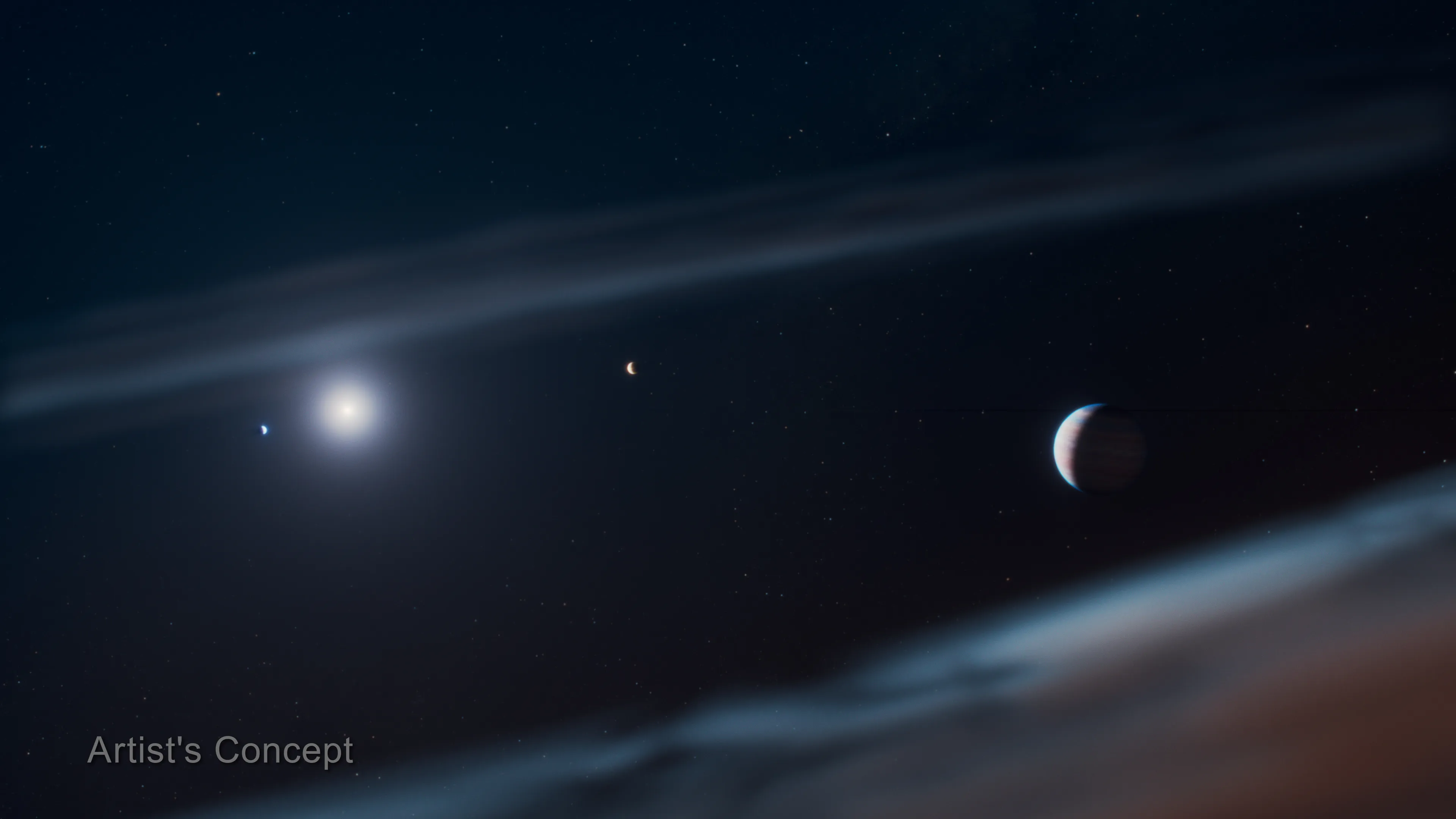
Approximately 63 light-years from Earth lies a planetary system so young that its less than 1 percent as old as our solar system. It is called Beta Pictoris, and—as far as astronomers have confirmed—it consists of a star more massive than the sun, three giant planets, and a huge disk of dust and debris.
The middle planet in the system, Beta Pictoris b, is a gas giant several times more massive than Jupiter. Being a gas giant, it likely does not have a solid surface on which to “land,” and at just a few tens of millions of years old, it can be considered a newborn planet in astronomical terms. It’s also one of the most extensively studied exoplanets through direct observation. Its youth keeps it hot and bright, and its distance from the star—similar to that between our sun and Saturn—makes it possible to distinguish from the star with sufficiently powerful telescopes.
The newly discovered third planet orbiting Beta Pictoris, Beta Pictoris d, appeared in reconstructed imagery from NASA’s James Webb Space Telescope. Modeling suggests its orbit is comparable to the region occupied by Neptune in our own solar system.
Now, a new study from researchers at Harvard and the University of Oregon claims that Beta Pictoris b is the source of something that has never before been unequivocally detected on another world: radio emissions.
Recorded by the MeerKAT radio telescope in South Africa, the signal is likely of natural origin, as in no, it’s not aliens .
Source link