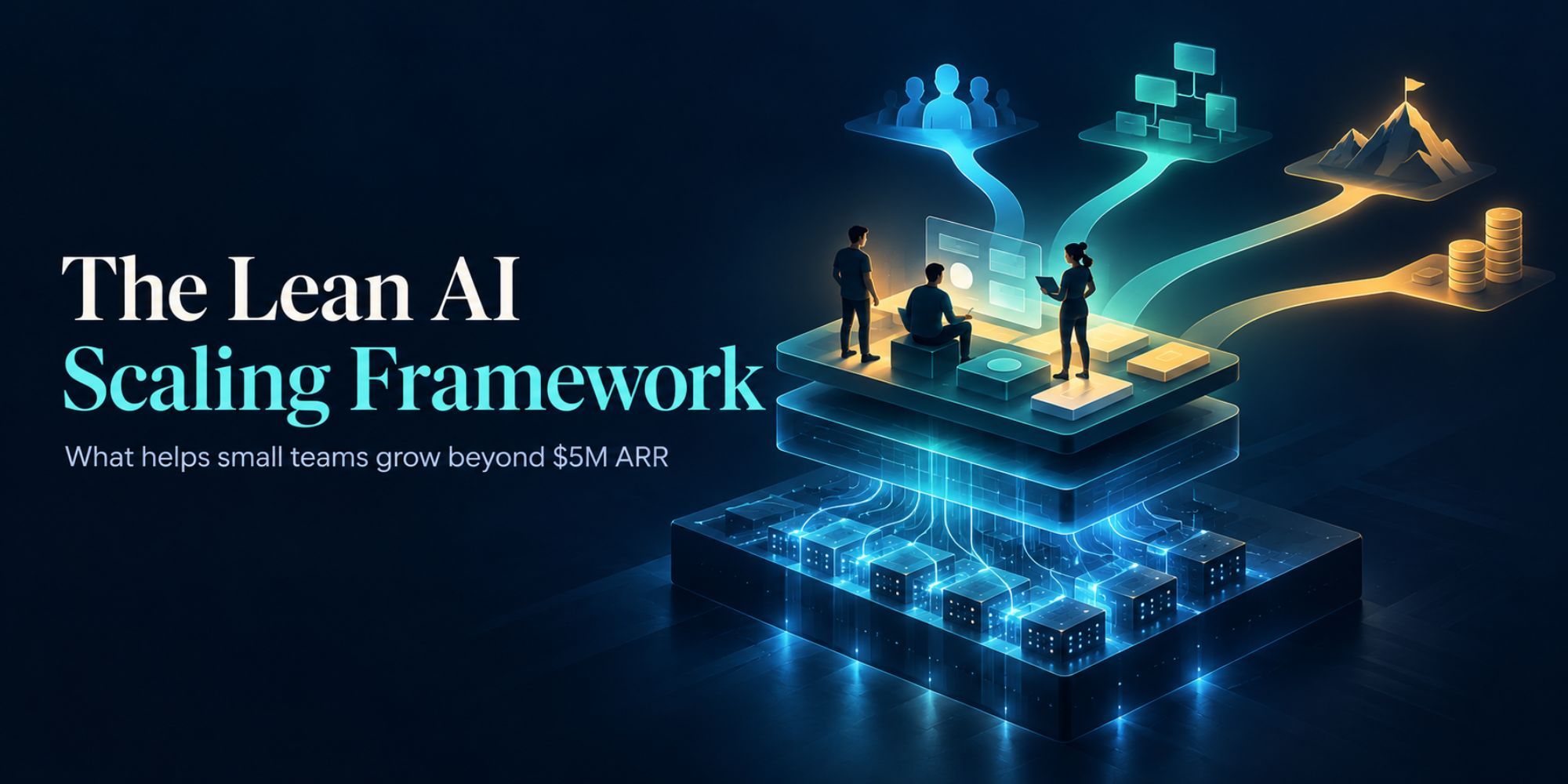
Every AI startup today starts from the same place. The same frontier models, the same open-source alternatives, the same rented GPUs. A two-person team in Bengaluru and a thousand-person incumbent buy them on nearly the same terms.
So why do a handful of small teams scale beyond $5 million in annual recurring revenue while most stall after their first round?
That is the question behind The Lean AI Scaling Framework, a September 2026 report by Suvan Ventures Managing Partners Radhesh Kanumury and Piyush Gupta, with research intern Rahul Maran. The team studied 25 AI-native B2B companies, from Cursor and Lovable to ElevenLabs, Vapi and Legora, and catalogued 124 publicly cited reasons for their growth. Those reasons collapsed into 73 tags and, eventually, seven recurring "scaling drivers."
For the purposes of this framework, a "Lean AI company" is defined as a company that has scaled to more than $5M in annual recurring revenue (ARR) with a core team of 10 people or more. Most companies in the 25-company sample meet this bar.
The report's starting premise is simple and direct. Since any company could ride the same AI wave, something other than AI access separates those that scale from those that don't.
What the wave did do was create opportunities. Problems that once needed a large specialist team and years of R&D became solvable by a small team on top of a purchasable or open-source building block. Natural-language coding became possible using frontier LLMs and AI coding agents, without building code-generation systems from scratch.
Source link