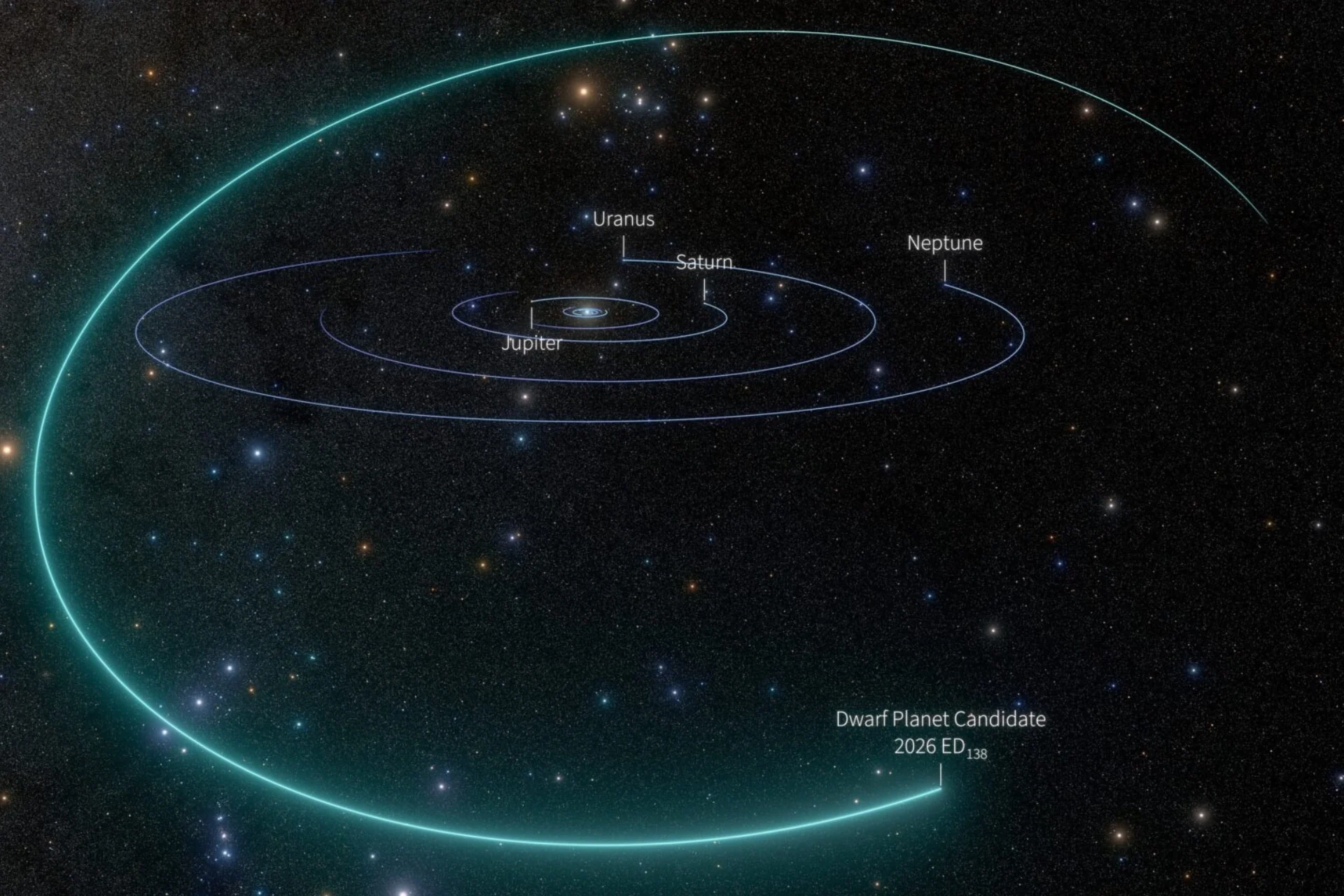
It’s been just four months since the Vera C. Rubin Observatory officially began its decade-long survey of the cosmos, and it’s already exceeding expectations. Rubin’s latest find—an icy world orbiting the Sun at a distance farther than Pluto—may be our solar system’s sixth dwarf planet. What’s more, this candidate appears to be among the largest and brightest objects ever discovered in this region of our cosmic neighborhood.
“Finding an object this big, roughly 1,000 kilometers [621 miles] across, is something that happens maybe once in a generation,” Mario Jurić, a professor of astronomy at the University of Washington and leader of Rubin’s solar system team, said in a statement. “It’s the largest trans-Neptunian object found in about 20 years, and Rubin turned it up while we were still commissioning the telescope.”
This dwarf planet candidate has been provisionally named 2026 ED138, and Jurić presented the discovery alongside Matthew Holman, a senior astrophysicist at the Harvard & Smithsonian Center for Astrophysics, at a press conference on Tuesday.
Holman first spotted ED138 while running Rubin data through a search code he co-developed to compare billions of detections of moving objects and find those that correspond to the same object. This object immediately caught his attention, as its brightness and distance suggested it was unusually large.
“My first reaction was one of excited disbelief,” Holman said in the statement. “Objects like this are very rare, so I immediately started checking whether I or the code had done something wrong.”
Rubin officially began its Legacy Survey of Space and Time in late June.
Source link