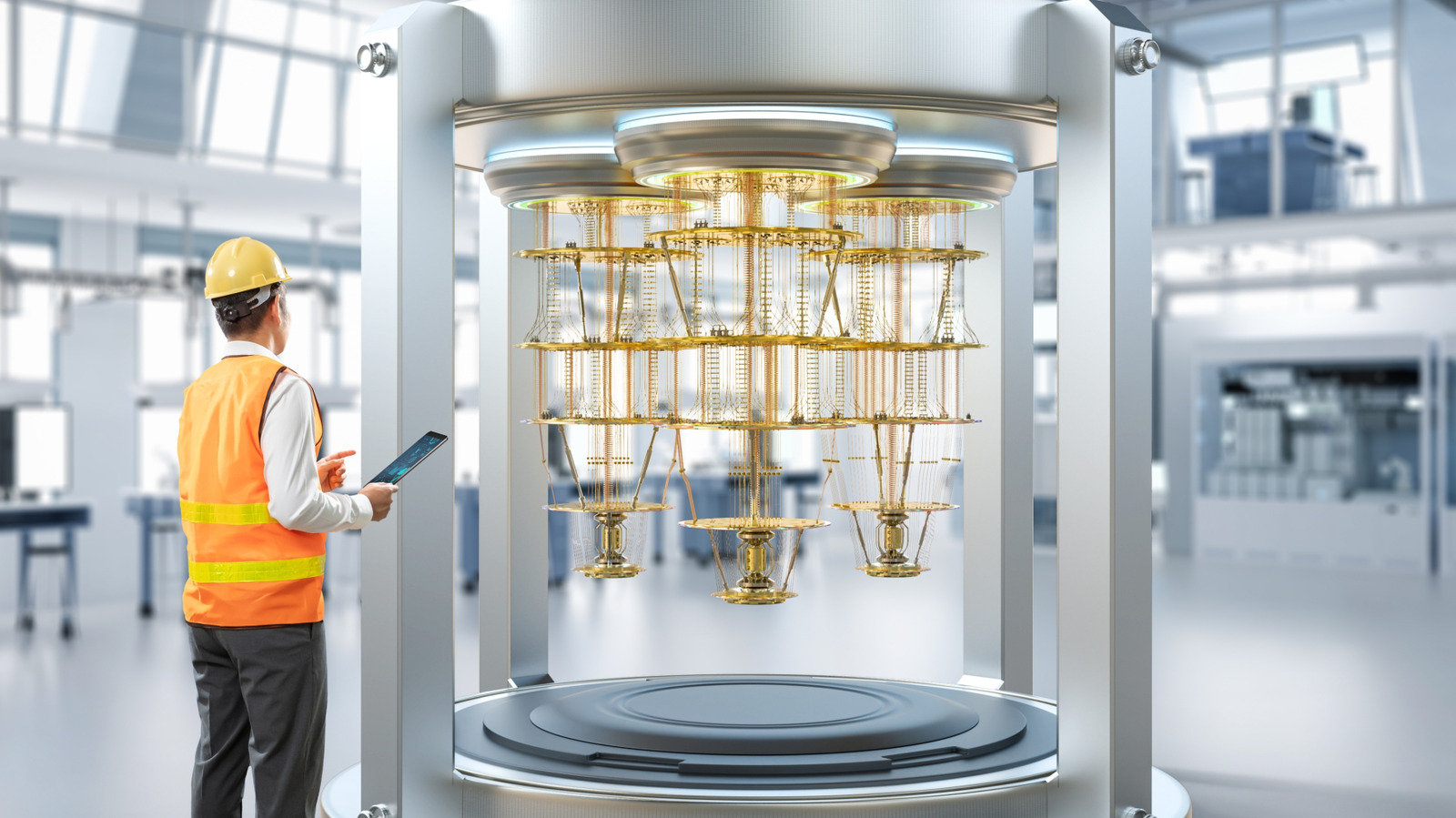
One of the coldest places in the universe isn't on some distant planet or at an empty point between galaxies. It's here on Earth, inside a lab. Deep space sits at about 2.7 Kelvin (454.8 degrees below zero in Fahrenheit), in the leftover glow of the Big Bang, according to Space.com. IBM's latest modular cryogenic system is cooled below 15 millikelvin, which the company describes as more than 180 times colder than deep space. That's a hair above absolute zero.
So how does IBM get a machine colder than deep space, and perhaps more importantly, why bother? How will it benefit us warm-blooded humans? The answer starts with what's being kept cold: the qubit.
Regular computers calculate using bits: tiny switches that are either 1 or 0, on or off. A qubit is closer to a dial than to a switch. It can hold many different positions between on and off. You can imagine the difference between the two like the difference between a light switch and a dimmer. In addition to that, each qubit also has a "direction" that carries information. So while a bit is either on or off, a qubit can hold multiple values in two different directions.
Bits also work alone: Each one switches on or off separately. Qubits can be linked together, so that what you learn about one tells you about the others. Picture a console of connected dials, where turning one shifts the rest along with it.
A quantum computer runs algorithms built so the wrong answers cancel out and the right one is left standing, much like waves on a lake that cancel in some spots and stack up in others.
Source link