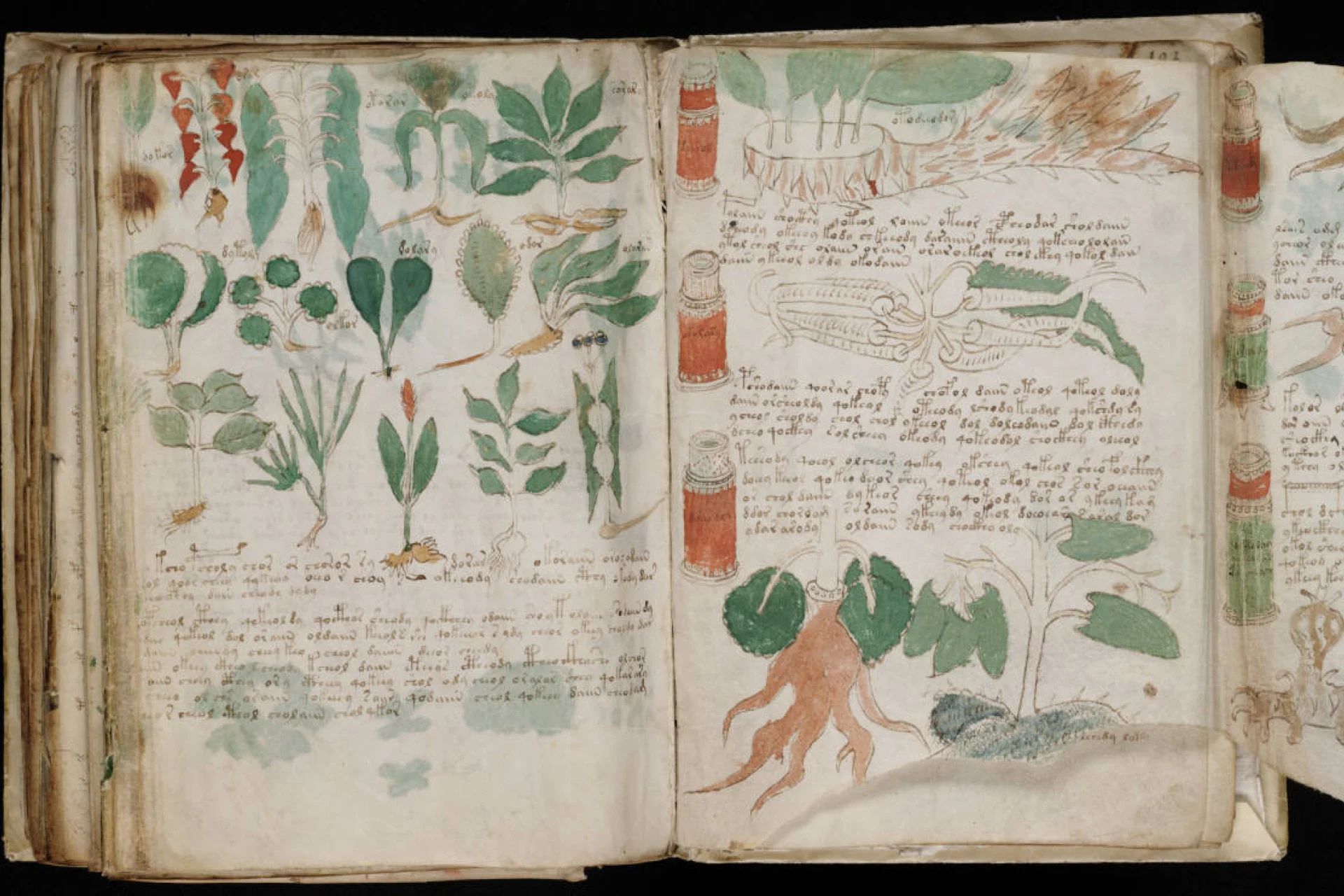
To quote medievalist Lisa Fagin Davis, there is “no medieval manuscript that has been seen, studied, analyzed, and debated more than the mysterious and as-yet-unread Voynich Manuscript.” Indeed, historians, linguists, and codebreakers have struggled to decipher this odd collection of letters—but what if there’s an issue with the manuscript itself?
New evidence, published in Digital Medievalist, suggests that the Voynich Manuscript was misbound. That is, the pages of the codex aren’t even in the right order, and that’s probably why we’re struggling to make sense of it. According to the study, the manuscript was probably intended to be read as a series of stacked bifolia, or sheets folded in half. But the version we have today was interpreted to be a quire, or folded pages sewn together to make a booklet. If true, it would partly explain why the manuscript appears so incomprehensible.
“This means that any research that relies on the current sequence of pages needs to be revisited, since the manuscript is out of order,” Davis, the executive director of the Medieval Academy of America, told Gizmodo. Davis co-authored the new paper with Colin Layfield, an information scientist at the University of Malta.
According to the Yale Library, where the manuscript currently lives, the codex was bought, sold, and gifted between many politicians and academics since the 16th century. Scholarly research on its contents began around 1912, when Polish American bookseller Wilfrid M. Voynich introduced it to the rare book market.
On first glance—as you can see for yourself here —the Voynich Manuscript looks like any other old book.
Source link