
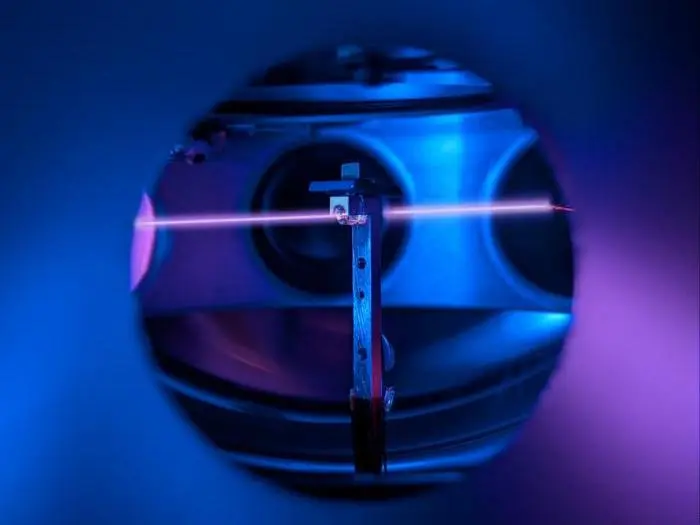
Researchers in Austria have officially built the world’s first prototype of a self-stabilizing nuclear clock. Developed at the Institute of Atomic and Subatomic Physics at TU Wien alongside Germany’s PTB Braunschweig, the system runs steadily for more than 24 hours entirely on its own.
Built around a laser-stimulated thorium crystal, the system automatically detects and corrects frequency shifts to remain stable. It is a milestone that could alter how humanity measures time, gravity, and the fundamental laws of nature.
Thorium-229 is the sole oddball among known elements. It has two energy states separated by an exceptionally small gap — small enough that a UV laser can intentionally flip its state. Other nuclei have energy gaps that are too large for lasers to excite.
In April 2024, research teams demonstrated this long-sought nuclear transition for the first time. Later that same year, the researchers coupled their thorium apparatus to an optical atomic clock, proving that these excited nuclei can serve as high-precision timekeepers.
Finding that elusive transition energy was step one. Turning it into an independent clock required something far trickier: a feedback loop.
“What you really want is a self-stabilizing nuclear clock,” explained Prof. Thorsten Schumm. “The basic idea is simple: you have a laser, and you have thorium. The laser changes the energy state of the thorium nuclei, and the thorium nuclei are used to stabilize the frequency of the laser.”
While the oscillation of this laser light provides the rhythm for timekeeping, environmental factors like temperature fluctuations can cause its frequency to drift.
Source link





