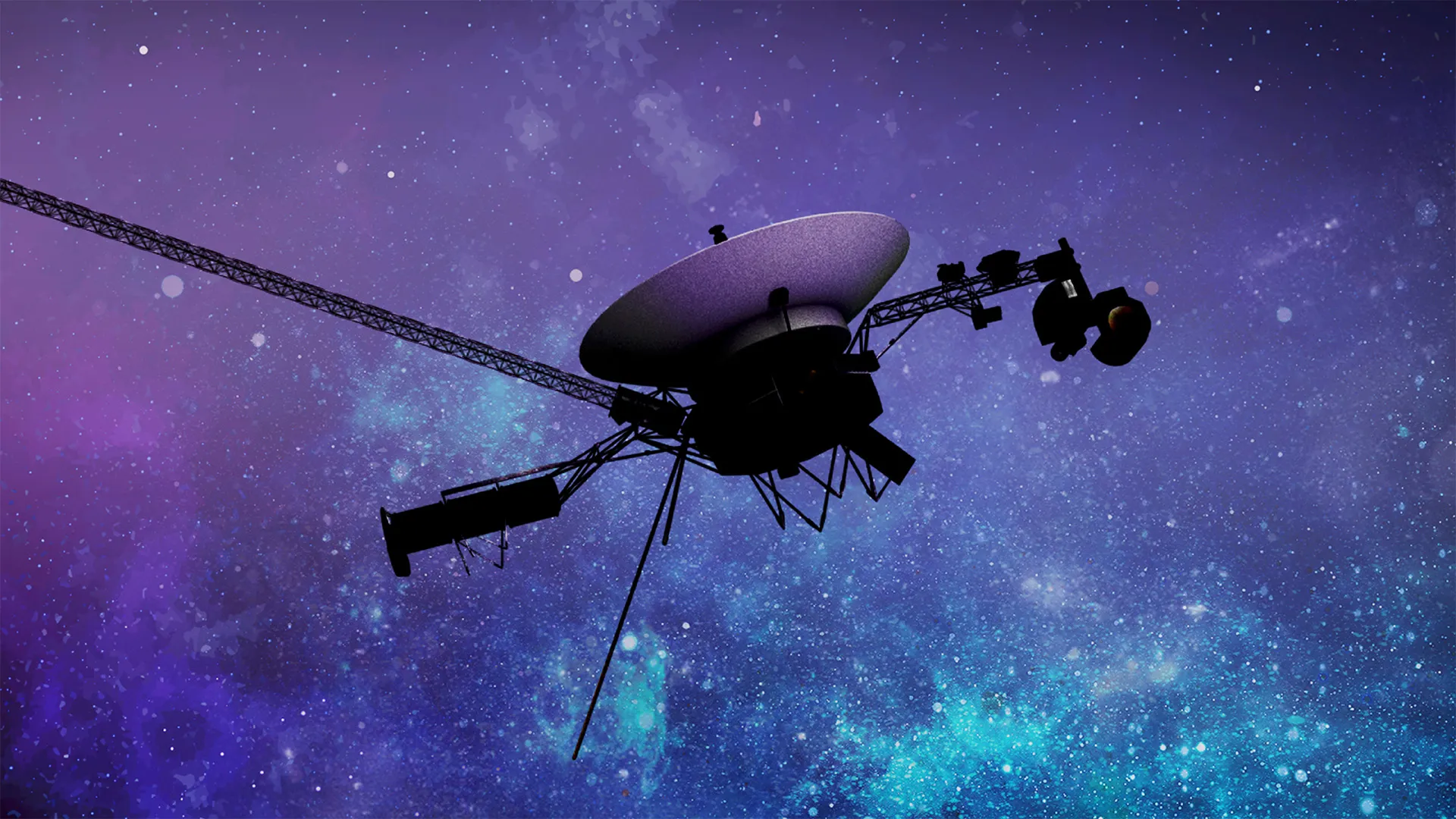
Traveling one light-day took the space probe 49 years. it would take a human 612,015 years to walk that distance.
NASA’s Voyager 1 spacecraft is on track to set another historic record as its mission approaches the half-century mark. On Nov. 18 at 5:16 a.m. ET, the probe will reach a distance of one light-day from Earth, a journey of nearly five decades that places it farther from our planet than any human-made object in history.
It’s quite an accomplishment for a spacecraft built in the mid-1970s One light-day is the distance that light travels in a single day at the speed of light, which is approximately 186,282 miles per second. That translates to 25.9 billion kilometers or about 16.1 billion miles in a single day. At an average human walking speed of 3 mph, it would take a human 612,015 years to walk that distance.
Fortunately, Voyager 1 has been traveling a bit faster than that. It currently zips along the cosmos at a steady 37,763 mph, a speed it achieved in 1980 after a gravity-assisted Saturn flyby. It has been flying at that speed ever since.
The milestone comes 14 years after its previous one, when Voyager 1 crossed the heliopause, the point where the sun’s heliosphere ends, and entered interstellar space. It’s also 28 years after passing Pioneer 10 to become the human-made object that has traveled the farthest into space.
The historic milestone isn’t without its drama. Voyager 1 has been in space for nearly half a century, and in that time, NASA’s Jet Propulsion Laboratory has done everything it can to extend the life of Voyager 1.
Source link