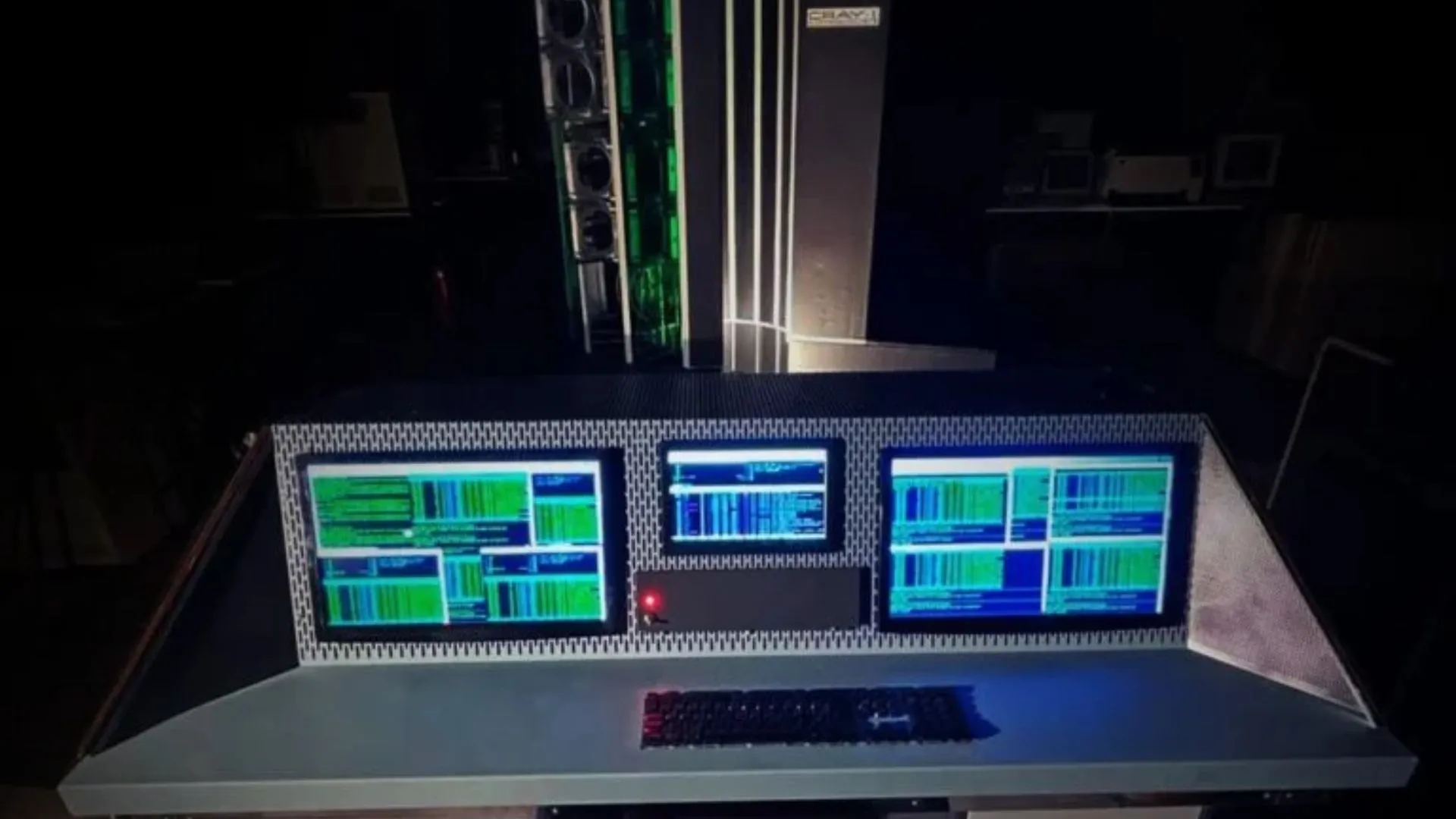
In a fitting tribute to the 50th anniversary of Apple’s founding and the first use of the Cray-1 supercomputer, the Museo de Historia de la Computación in Spain unveiled a Cray-1 replica built by repurposing 30 Mac Minis. The project took 18 months to build and is now open to the public.
At first glance, the idea of building a supercomputer replica with compute from vintage chips seems quite futile. However, one must remember that although the world’s first commercially successful supercomputer, the Cray-1 was first operational in Los Alamos in 1976. There is a huge gap in computing prowess of chips today and those that were launched a decade ago.
Imagine stretching this further to five decades with Moore’s Law in mind. Even if the computing prowess of a single modern-day chip might still be less than Cray-1, when you are putting together chips from 30 Mac Minis from 2012-14, the difference will become obvious.
The museum team sourced 25 dual-core i5 units and five quad-core i7 units, bringing the total computation capacity of the replica device to 1.5 TeraFLOPS. In comparison, the original Cray-1 boasted peak capacity of 160 MegaFLOPS. This a still a 9,375x jump over the original supercomputer’s capabilities and shows how powerful chips have become over the years.
Nevertheless, Cray-1 was still an extremely popular system in its day and sold more than 80 installations during its time. It was extremely popular with science and engineering institutions that wanted to churn massive datasets to make accurate predictions in areas such as weather forecasting, aerodynamics and even nuclear physics.
Source link