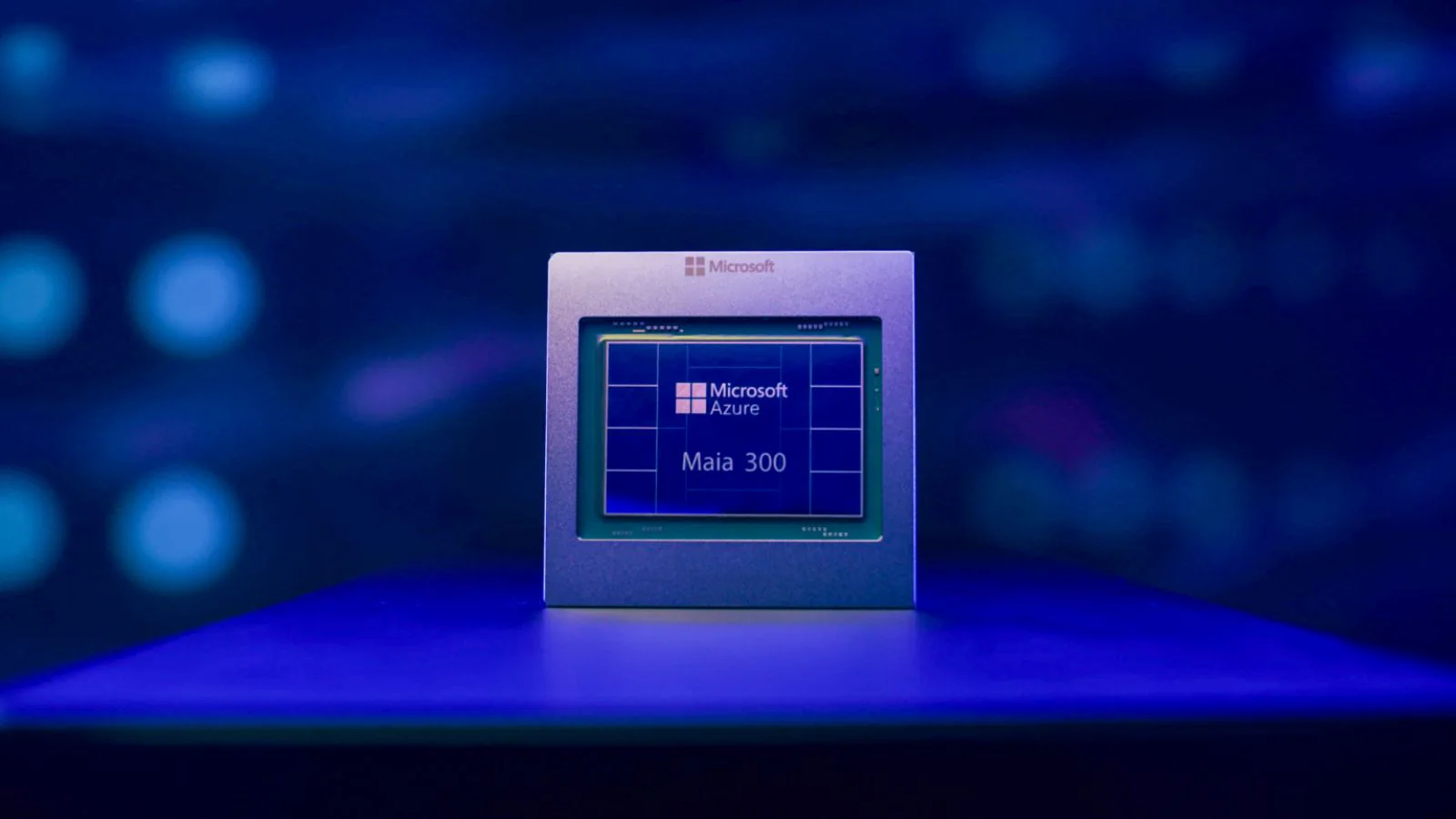
Microsoft has unveiled Maia 300, its latest custom artificial intelligence (AI) chip, as the technology giant steps up efforts to build its own AI infrastructure and reduce its reliance on third-party processors from companies such as Nvidia and AMD.
Announced at the OCP Global Summit 2026 in San Jose on Monday, October 12, Maia 300 is designed to handle increasingly demanding AI inference workloads, including long-context reasoning, conversational applications and multi-step tasks performed by AI agents.
Microsoft expects Maia 300 to deliver 40% more tokens per megawatt than leading graphics processing unit (GPU)-based systems. A rack containing 96 accelerators is also expected to deliver up to seven times the rack-scale token throughput of its predecessor, Maia 200.
The company plans to begin production deployments of Maia 300 in 2027, when it also intends to scale its Azure Maia family to multi-gigawatt deployments. Microsoft expects Maia 300 to become the primary inference system for its products and services.
While Maia 300 is still some time away from production deployment, its predecessor is already being used across Microsoft’s AI infrastructure.
The company said Maia 200 is serving production workloads, including Microsoft Copilot, while supporting its Microsoft AI (MAI) team in developing next-generation models. GitHub Copilot and Microsoft Foundry are expected to follow by the end of 2026.
Maia 200 supports OpenAI models, Microsoft’s own MAI models and leading open-source model families. The chip is being deployed across the United States, Europe and Australia, according to the company.
7 times more tokens per watt for built-in AI capabilities in Microsoft Teams, Copilot and Cowork experiences than leading GPU infrastructure.
Source link