The cataclysmic impact winter that befell the globe after the infamous Chicxulub asteroid collided with Earth roughly 65 million years ago was a veritable feast for fungi ready to devour all of the decaying life suffering through the Cretaceous-Paleogene era’s mass extinction event. Some of the world’s earliest known parasitic “zombie” fungi were already busy feasting during the Cretaceous—but now researchers in China have found evidence that an entirely new family of fungal species arose in apparent response to the Chicxulub impact.
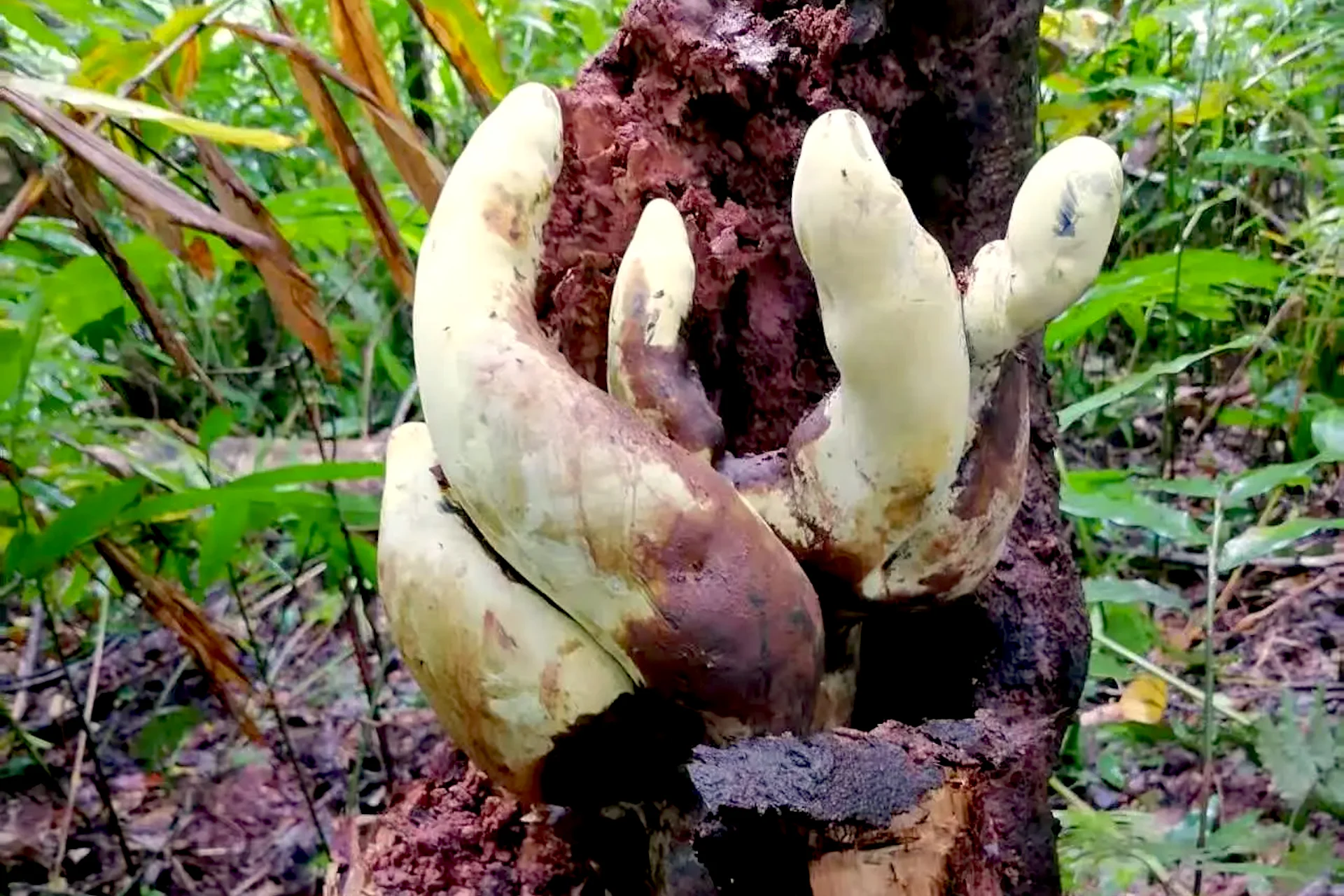
And it’s a behemoth. An international team of mycologists, botanists, and other researchers has uncovered a gigantic, nearly 20-inch (50-centimeter) tall, 4.9-pound (2.2-kilogram) new fungus deep within the forests of Yunnan Province in south China. The newly discovered species, a member of the order Xylariales known to consume dead wood, has been named Dianjunus rex (D. rex for short), in honor of its king size and prehistoric origins.
Mycology specialist Indunil Senanayake and her coauthors deployed a “molecular clock” technique to assess when D. rex first emerged, comparing its genome to the DNA of hundreds of other fungi whose evolutionary timeline is well documented. Tellingly, according to their new study published in Frontiers in Fungal Biology, Dianjunus rex appears to date back to somewhere approximately 65 million years ago.
“This timing raises an intriguing possibility,” Senanayake said in a statement. “After the mass extinction, forests experienced dramatic changes, including the sudden availability of large amounts of dead plant material.
Source link