
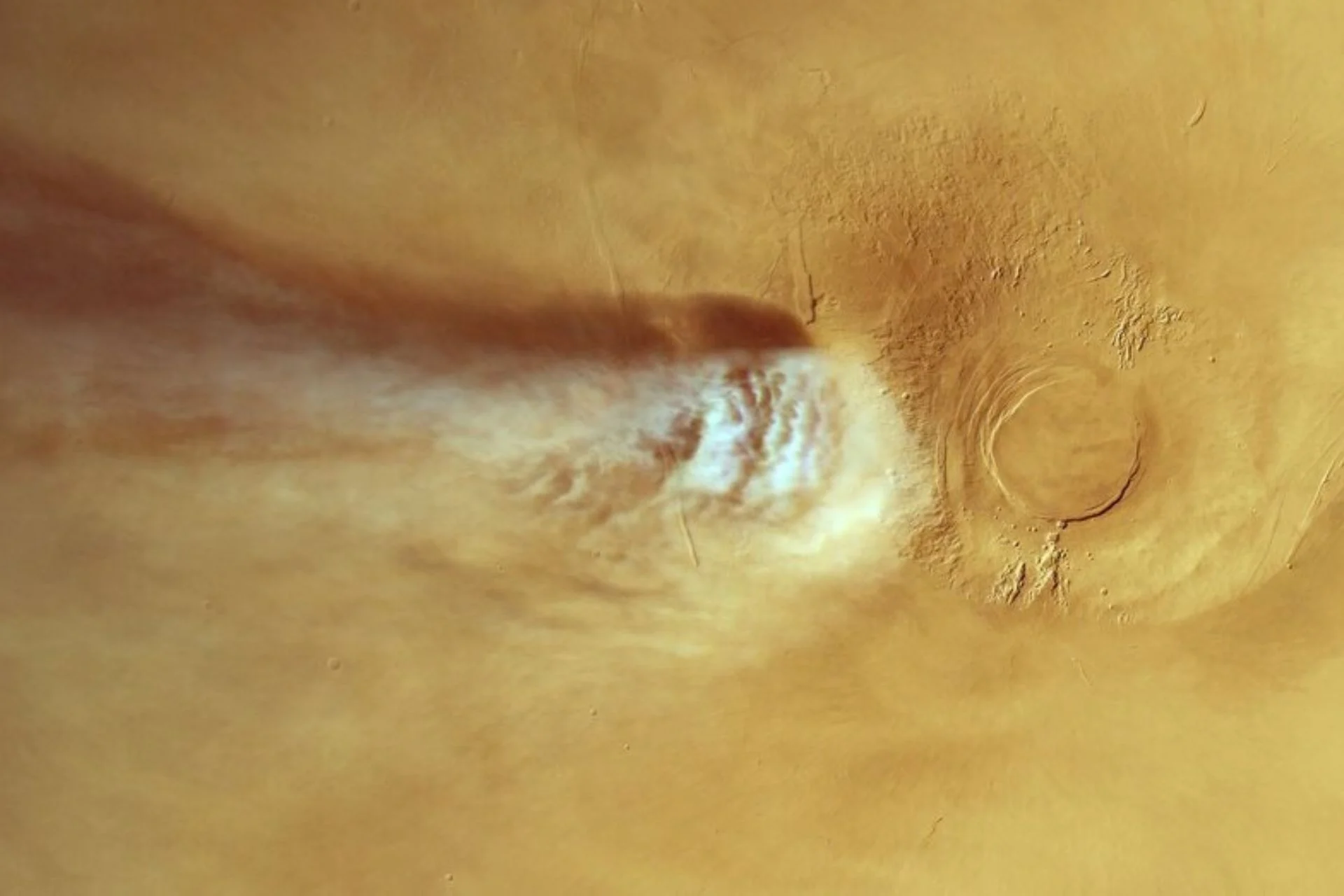
During Mars’s dusty season, which runs through spring and summer in the Red Planet’s southern hemisphere, a wispy cloud of water ice appears downwind of the enormous Arsia Mons volcano. Aptly named the Arsia Mons Elongated Cloud (AMEC), this thin white line forms each day at sunrise, grows up to 1,100 miles (1,800 kilometers) long in just three hours, detaches from the volcano, and then disappears.
The European Space Agency’s Mars Express orbiter first spotted the AMEC back in 2018, according to the agency. Its bizarre behavior has perplexed scientists ever since. Studying the satellite’s observations has revealed that it is an orographic cloud, which forms when a mass of air is forced upward by elevated terrain. Orographic clouds appear on Earth too, and the physical mechanisms behind their formation are well understood. But attempts to model how the AMEC forms couldn’t reproduce the cloud accurately.
It turns out the researchers may have been relying on the wrong physics.
In a study published Wednesday in the journal Nature Geoscience, a team of planetary scientists finally managed to model what Mars Express had long observed. The trick, according to lead author Jorge Hernández-Bernal of Sorbonne Université in Paris, France, was including some exotic physics—theoretical phenomena thought impossible to work in an actual atmosphere.
“It certainly hasn’t been seen in action before,” Hernández-Bernal said in an ESA statement. “Once we included this physics in our simulations, the AMEC emerged just as we hoped.”
Here on Earth, clouds form via heterogeneous nucleation, when water vapor condenses on microscopic particles of dust, sea salt, or other dry materials in the atmosphere.
Source link





