
This article has been reviewed according to Science X's editorial process and policies. Editors have highlighted the following attributes while ensuring the content's credibility:
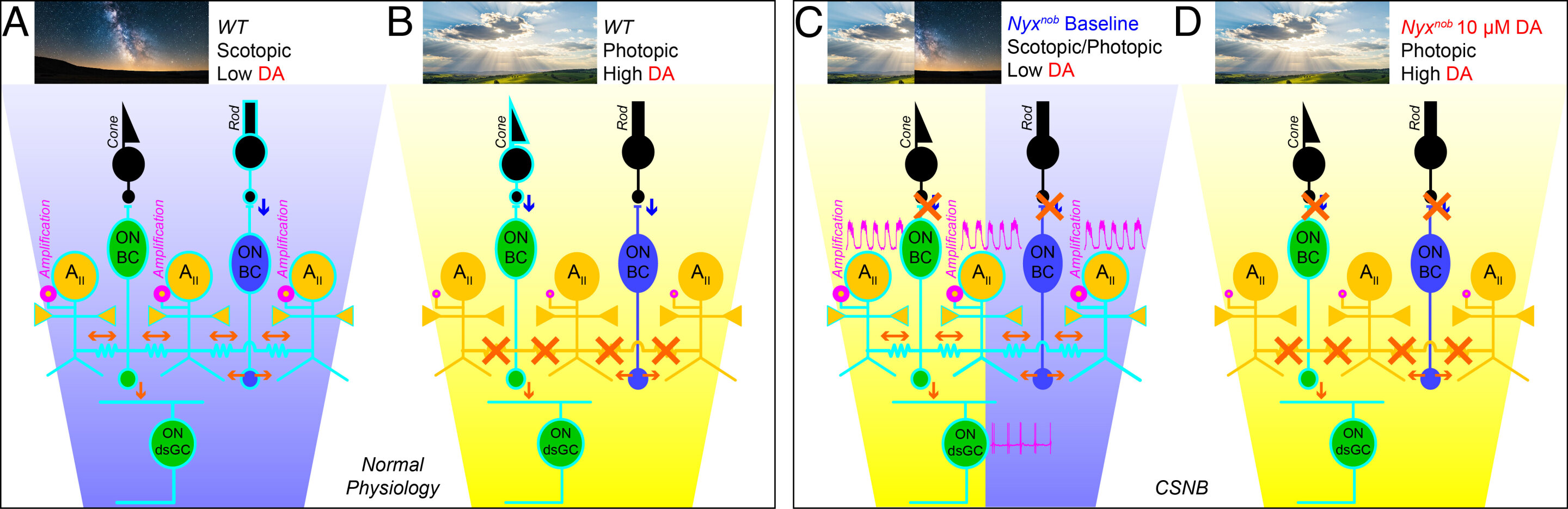
Researchers have found a possible way to stop abnormal signals in the retina that are linked to involuntary eye movements (nystagmus). In experiments on mouse retinas in the lab, restoring dopamine signaling stopped these abnormal signals and reduced the "noise" that interferes with visual signals—offering a potential dual benefit of quieting the abnormal eye movements while also increasing visual acuity. The next step is to find out whether the approach also works in living animals.
Nystagmus causes involuntary, repetitive eye movements and can reduce vision. It is often seen in people with congenital stationary night blindness (CSNB), an inherited form of night blindness. There is currently no cure for the condition.
Nystagmus has traditionally been thought to originate in the brain, in the circuits that control eye movements. But previous research by the team showed that, in this form of night blindness, the problem starts in the retina—the light-sensitive layer at the back of the eye. Cells in the retina produce abnormal rhythmic electrical signals, which are then passed on to the brain and trigger the involuntary eye movements.
In the new study, the researchers investigated why these abnormal signals occur. They focused on dopamine, a chemical messenger that helps the retina adapt to light and darkness. In this form of night blindness, dopamine release in the retina is reduced.
Using retinas taken from a mouse model of night blindness, the researchers found that restoring dopamine signaling stopped the abnormal electrical activity.
Source link





