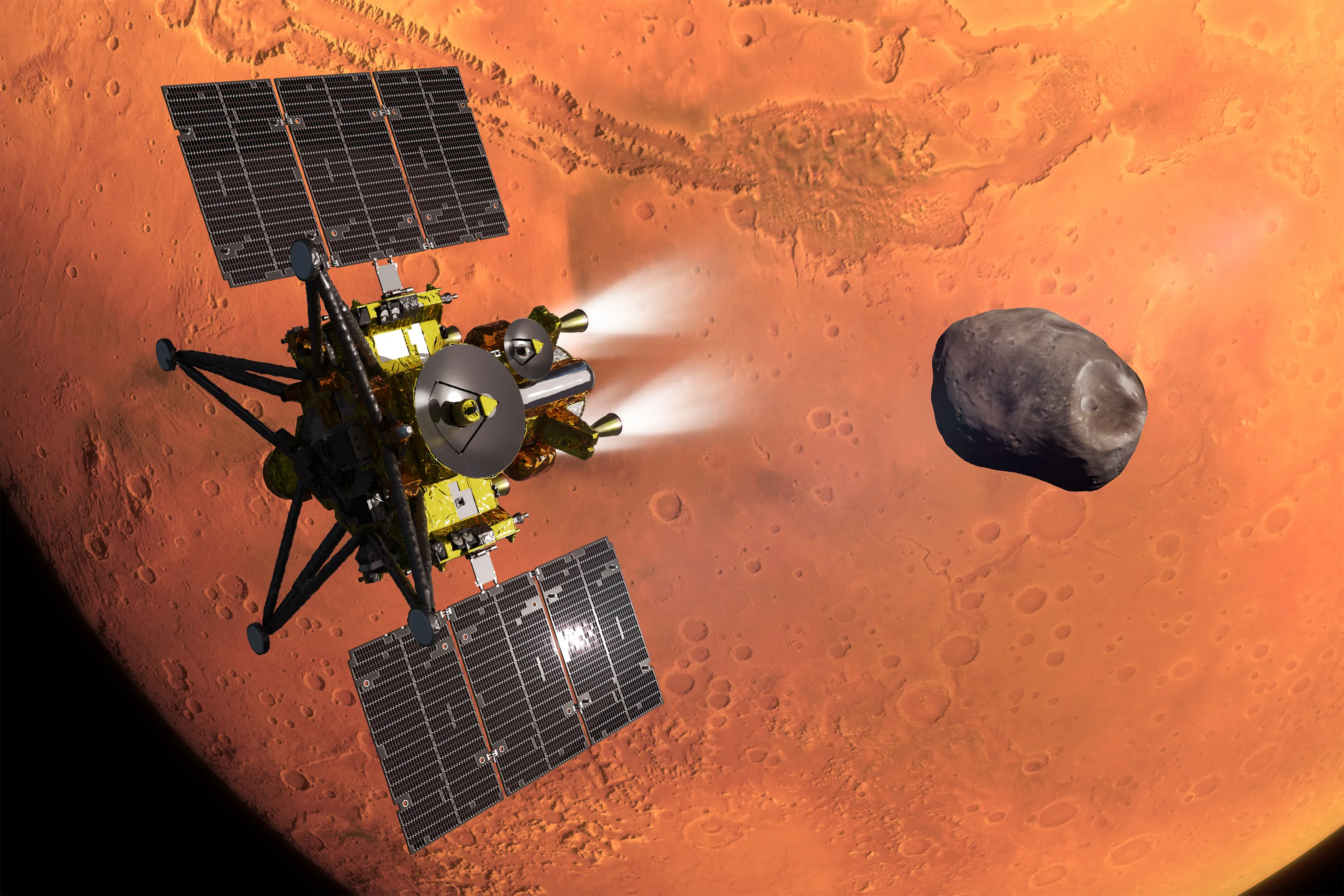
It’s difficult to imagine a more daunting journey than one to an alien moon named after the Greek god of fear—especially when three other attempts to make that journey have failed.
And yet, as Japan’s space agency, JAXA, and its collaborators gear up to send a spacecraft to Mars’ formidably named moon, “all the members are filled with a quiet sense of excitement,” says Kiyoshi Kuramoto, who leads the mission’s slew of international scientists.
This mission, called the Martian Moons eXploration (MMX), is set to launch from Japan’s Tanegashima Space Center in the wee hours of Tuesday in Japan (Monday afternoon in the US). After almost a year of travel, the spacecraft will reach Mars and its two moons: Phobos, meaning fear in Greek, and Deimos, meaning dread. MMX will observe the pair from afar and collect samples from Phobos in a bid to answer a looming scientific question: How, exactly, did the moons come to be?
Researchers have been attempting similar gambits for decades. Since the 1980s, Russia has sent three probes to Phobos, all of which failed. Still, researchers are anxious to achieve this mission impossible because the origin of Phobos and its sibling remains a mystery. Some of their attributes, such as the pattern of visible light they reflect, suggest they are asteroids captured into Mars’ orbit by its gravity. But the moons’ circular orbits in line with the Martian equator indicate that they could have formed from debris left over from a collision between a nascent Mars and a gigantic asteroid, Tom Statler, MMX program executive at NASA, said at a press briefing.
Source link