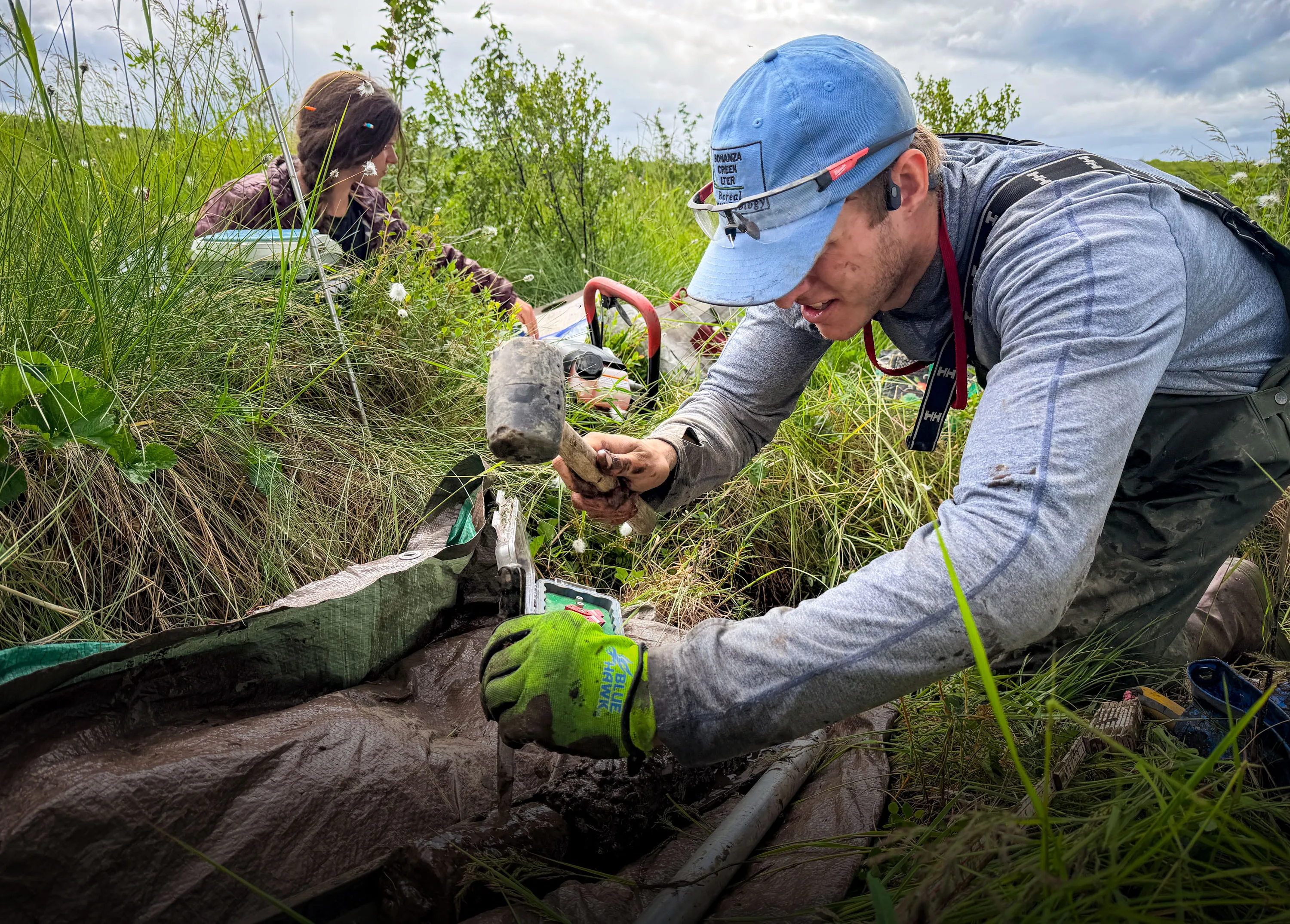
Andrew Haverdink, a tall grad student in a rain bib and rubber boots, wrenched a double-handed drill from the frozen soil that underlies much of Alaska’s Denali National Park and then unclipped the hollow barrel from the end of the bit.
He knelt in front of a blue tarp, lined the barrel up with a plastic tray, and pushed a rod through the opposite end. A perfect solid, cylindrical core of ancient soil emerged—dark, rich permafrost at least a foot long.
On that late morning in early July, Haverdink was among a team of Northern Arizona University students and staff gathering samples and data from a research plot, divided by surveyor’s tape unspooled atop tussocks, alders, and fireweed.
In late June of 2013, a lightning strike sparked a fire in this stretch of mostly treeless tundra, in the northern backcountry of the park. Whipped by the Chinooks, intense downslope winds created as moist ocean air surmounts and then descends the Alaska Range, the fire ripped across nearly 35,000 acres. It burned through much of the vegetation and deep into the topsoil, stripping away the insulating layer that preserves the frozen permafrost, a massive storehouse of carbon that underlies 85% of Alaska.
During their first survey, in 2016, the researchers found that in places where the fire burned hottest and deepest, the thawed soil above the permafrost (known as the active layer) extended between a foot and nearly two feet deeper than in plots outside the burn scar—an indication of deep thawing.
Source link