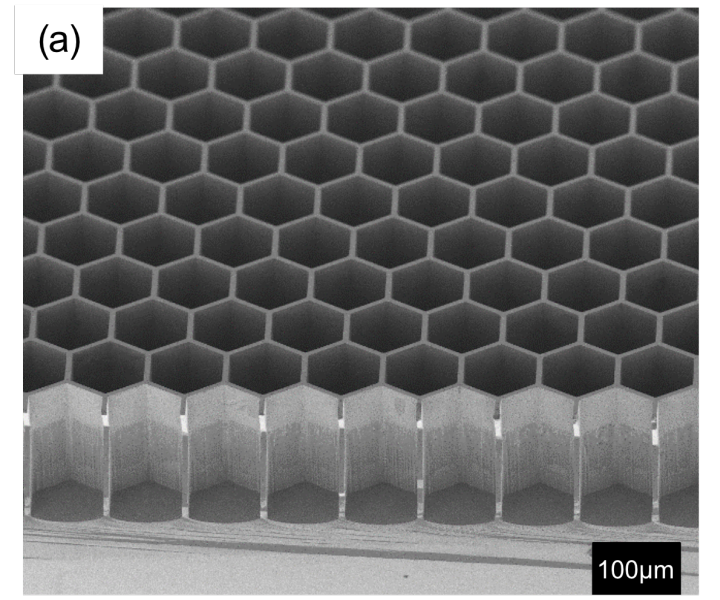
Scientists at Fraunhofer IZM have sculpted something unexpected into a slice of silicon: a 250-micrometer-deep honeycomb pattern. This microscopic structure is designed to untangle one of particle physics’ most elusive mysteries — the mass of the neutrino.
The development comes from a collaboration between researchers at Fraunhofer IZM and the University of Münster. Together, they have developed a wafer-scale manufacturing process for a novel “3D energy-filter diode.”
While the current 3D energy-filter diode remains a demonstrator, it establishes the technological blueprint for an entirely new generation of angle-sensitive particle detectors. The technology could improve precision experiments like the KATRIN neutrino mass experiment.
This device measures a particle’s energy and even the angle at which it hits the detector. That angular insight is important. In major experiments like KATRIN (the Karlsruhe Tritium Neutrino Experiment), scientists inspect the ultra-fine energy spectrum of tritium beta decay to pinpoint neutrino mass.
The effort is constantly plagued by background noise. “Imposter” electrons strike the detector with nearly the exact same kinetic energy as the genuine signal electrons.
Background electrons typically arrive at shallow angles under ten degrees. Signal electrons, on the other hand, enter at steep angles up to 50 degrees. Conventional particle detectors operating inside strong magnetic fields and ultrahigh-vacuum conditions are completely blind to this angular difference.
The new honeycomb design changes it. When incoming particles enter the microscopic hexagonal pits etched into the Si-PIN diode, wide-angle signal electrons hit the active sidewalls and trigger a clear signal. Shallow-angle background electrons pass straight through to the inactive floor.
Source link