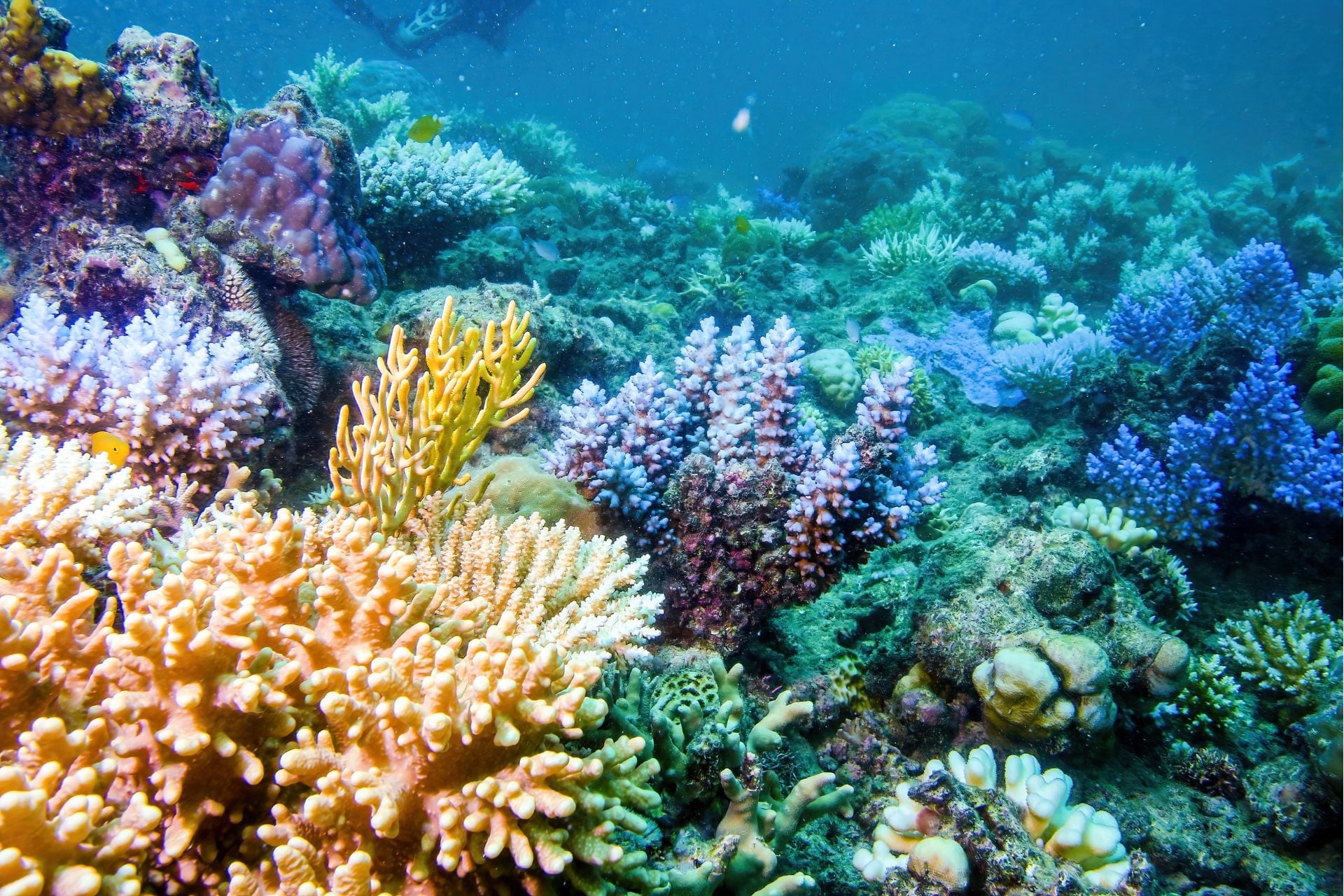
Few ecological crises capture the severity of climate change like the loss of Earth’s coral reefs. Global coverage of living corals has already declined 50% since the 1950s, largely due to rising ocean temperatures and worsening marine heatwaves. A new report shows just how dire this situation will become if global warming continues unabated.
Scientists with the International Union for the Conservation of Nature’s Red List of Ecosystems have assessed the world’s shallow coral reefs for the first time, and the findings are stunning. The analysis—spanning 127 reef ecosystems across more than 80 countries and territories—shows that 96% are now critically endangered and face an extremely high risk of collapse in the next 50 years.
“Corals carry a deep evolutionary record of coping with environmental change, yet the reef ecosystems we see today are remarkably young, shaped over only the last 5,000 to 7,000 years of stable climate,” Marcos Valderrábano, program manager for IUCN’s Red List of Ecosystems, said in a statement. “Ocean warming is now outpacing anything in their history, and recurring heatwaves are causing mass bleaching faster than reefs can recover or adapt.”
Since the late 1990s, Earth has experienced four mass coral bleaching events. The most recent lasted from early 2023 to late 2025, and during that period roughly 84% of the world’s reef area was subjected to bleaching-level heat stress.
Bleaching occurs when stressed corals expel their zooxanthellae—symbiotic algae that supply them with nutrients and give them their signature bright colors. Bleached corals aren’t immediately killed, but they are starving.
Source link