Scientists in South Korea have created a new, ultra-cheap component for making green hydrogen from water and electricity.
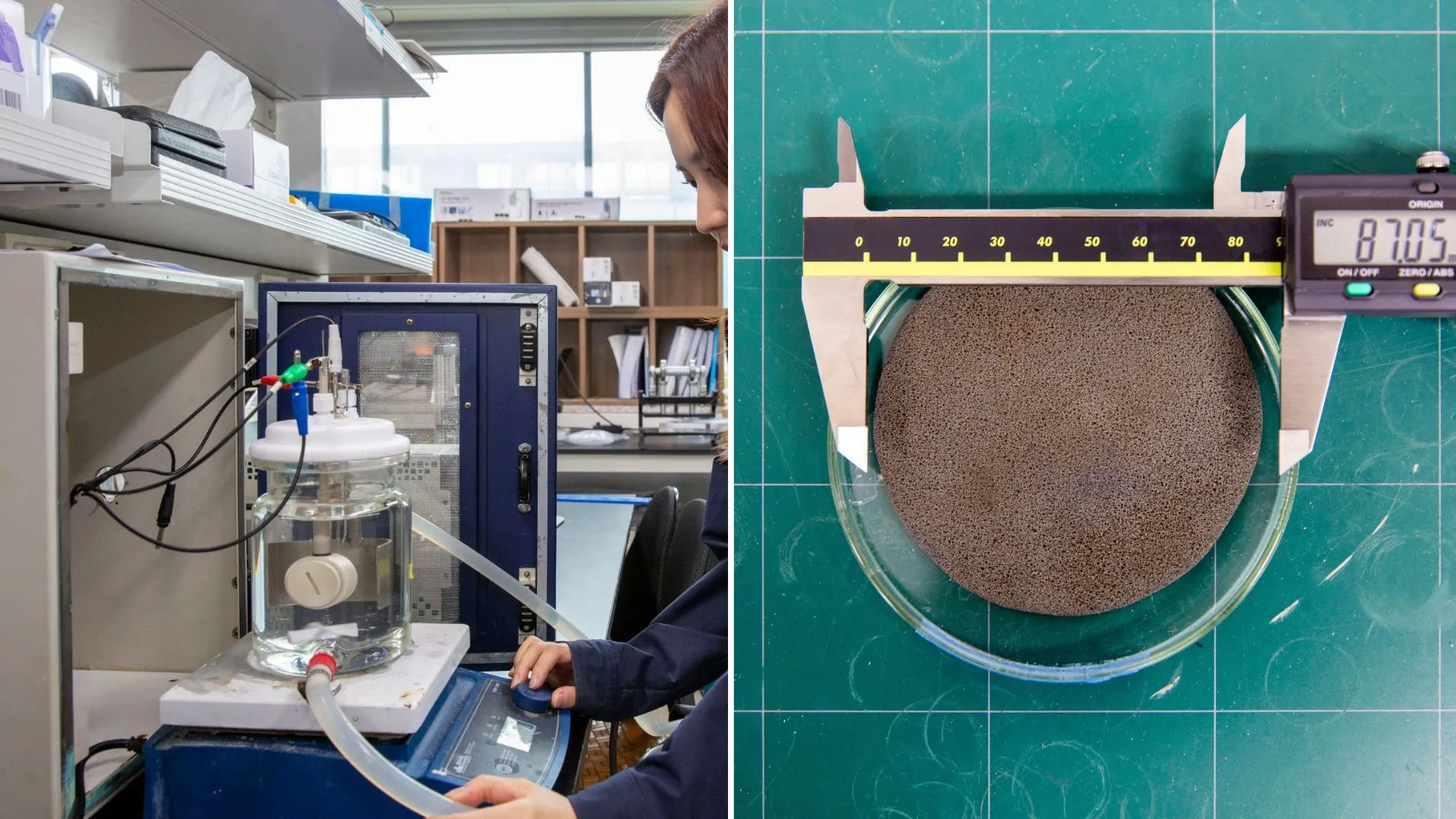
The Korea Institute of Energy Research (KIER) developed a platinum-free, nickel-cobalt electrode for efficient alkaline water electrolysis. This non-precious Ni/Co heterostructure electrode enhances performance and lowers costs in alkaline water electrolysis.
This advance has the potential to remove the primary economic barrier to scaling green energy globally.
“This research proves that non-noble-metal electrodes can achieve world-class performance and durability in alkaline water electrolysis,” said Dr. Kyung-Soo Kang, the lead researcher of the study at KIER.
Water electrolysis is wonderfully simple on paper. Send an electric current through water, split the molecules, and capture pure hydrogen gas with zero carbon emissions.
In practice, particularly within large-scale alkaline systems, the reaction is slow. Under alkaline conditions, splitting water molecules takes over 100 times longer than in acidic environments. To speed things up, industrial electrolyzers use precious metals.
Platinum trades at roughly $58 per gram, while ruthenium commands around $54 per gram. Multiply those numbers by the scale of industrial plants, and mass production becomes economically unviable.
The KIER team decided to give up platinum altogether. And built an electrode using nickel and cobalt, priced at a modest $0.02 and $0.05 per gram, respectively.
How do cheap metals beat platinum? The credit goes to the smart architecture.
The team created a dual-component heterostructure that pairs nickel oxide and a nickel-cobalt alloy on a single electrode surface.
Nickel oxide acts as a chemical catalyst, rapidly pulling water molecules apart during the sluggish initial dissociation step.
Source link