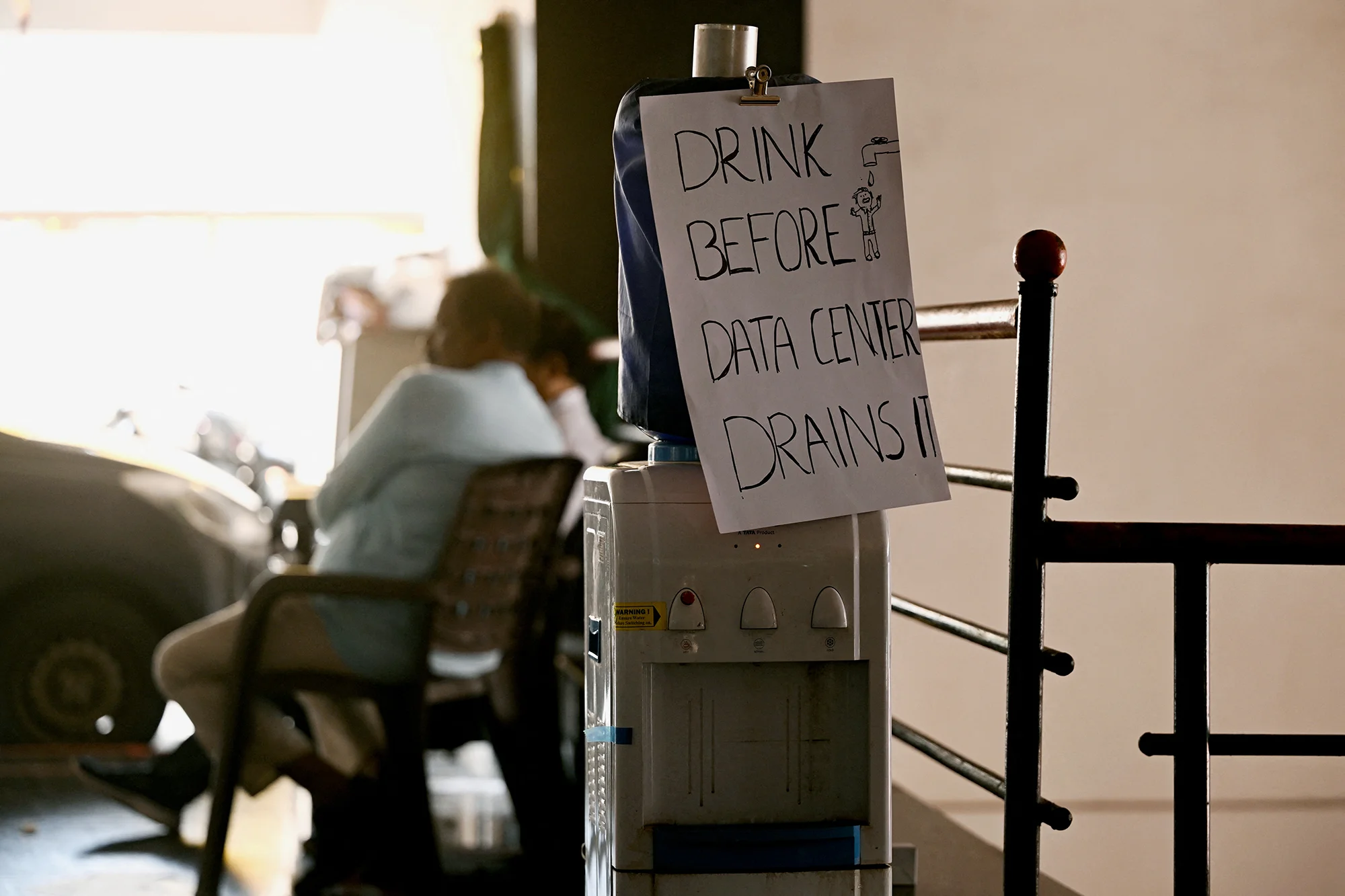
In his new book “Hyperscale: The Ambition and Excess of Big Tech’s Data Empires,” writer Paris Marx examines how local communities are resisting the growing demand for water to cool data centers.
After ChatGPT was released in November 2022, the tech industry was quick to herald the chatbot as the marker of a new wave of technological progress. As companies pushed to create more powerful AI models, the water demand of their ambitions took a while to become clear. In April 2023, a research paper out of the University of California estimated that training the large language model behind the initial version of ChatGPT had required 185,000 gallons of water. For every extended conversation someone had with the chatbot or every time they asked it to write an email, they were effectively pouring a bottle of water down the drain.
That statistic got a lot of play when it was released. It became an early warning sign of what was coming as companies pushed chatbots as a universal technology that could replace psychologists, educators, lawyers, and even people’s friends or partners.
As public concern grew, Google and OpenAI came out with their own figures. The companies suggested that querying one of their chatbots used mere drops of water. Independent researchers were not impressed, arguing the companies were taking a narrow view of the water use necessary to power and cool increasingly monstrous data centers. Those water demands can be quite significant too.
A hyperscale data center can suck up between 1 and 5 million gallons of water a day, comparable to the amount used by a city of 10,000 to 50,000 people — depending on the part of the world we’re talking about.
Source link