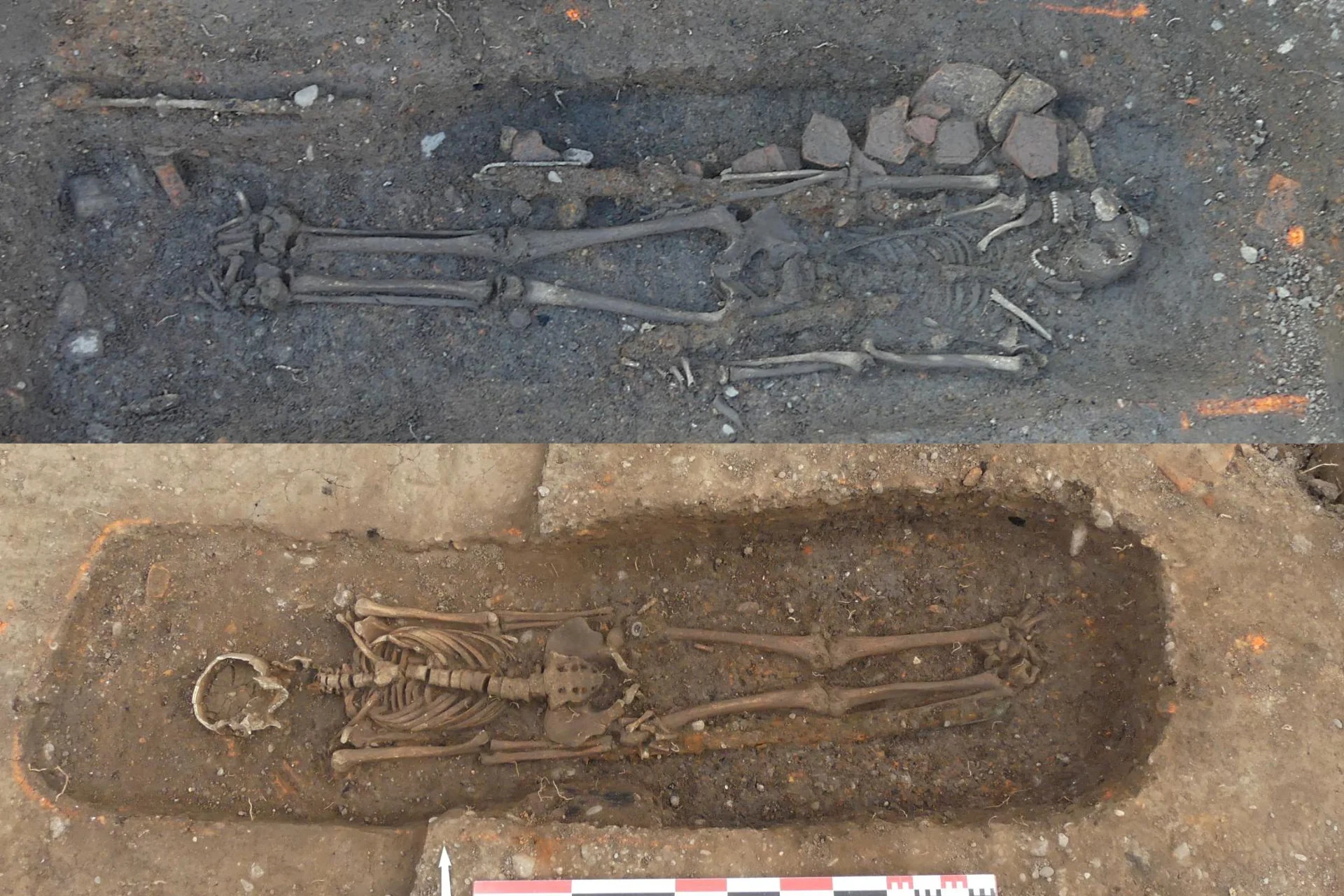
Archaeologists have found a 1,500-year-old cemetery in eastern France’s Alsace region, including lavish burials and horse graves.
On Friday, the French National Institute for Preventive Archaeological Research (INRAP) announced the discovery of an “exceptional” 5th-century funerary complex in Horbourg-Wihr, a town near the city of Colmar, including gorgeous burial goods. The complex, among other findings, provides insight into the obscure transition from the Roman Empire to the Merovingian era in Alsace.
The excavations took place within the context of preventive archaeological work executed ahead of a housing construction project. Archaeologists unearthed 11 adult or older adolescent graves, three child graves, and two horse graves, along with varying amounts of burial objects. Two male burials were particularly notable. In their graves, archaeologists found a sword in a semi-preserved wooden scabbard, a shield, a scramasax (a single-edged blade used by the Anglo-Saxons), and an angon (a kind of javelin used by Germanic warriors).
According to the translated INRAP statement, these objects indicate that the males were either Germanic chieftains or foederati (members of tribes allied to the Roman Empire) incorporated into Rome’s 5th-century army. The team also found gold and silver decorative elements that would have originally graced weapons and clothing, further proving their high-class ranks.
As for the other burials, two seem to have belonged to women, yielding objects such as pairs of silver-gilt looped brooches, silver bird-shaped brooches, glass bead necklaces, belt buckles, and a bone comb. Horses were also buried within the cemetery with their harnesses. The cemetery as a whole dates back to the second half of the fifth century, the same period that saw the last Western Roman emperor overthrown by the German chieftain Odoacer in 476.
Source link