
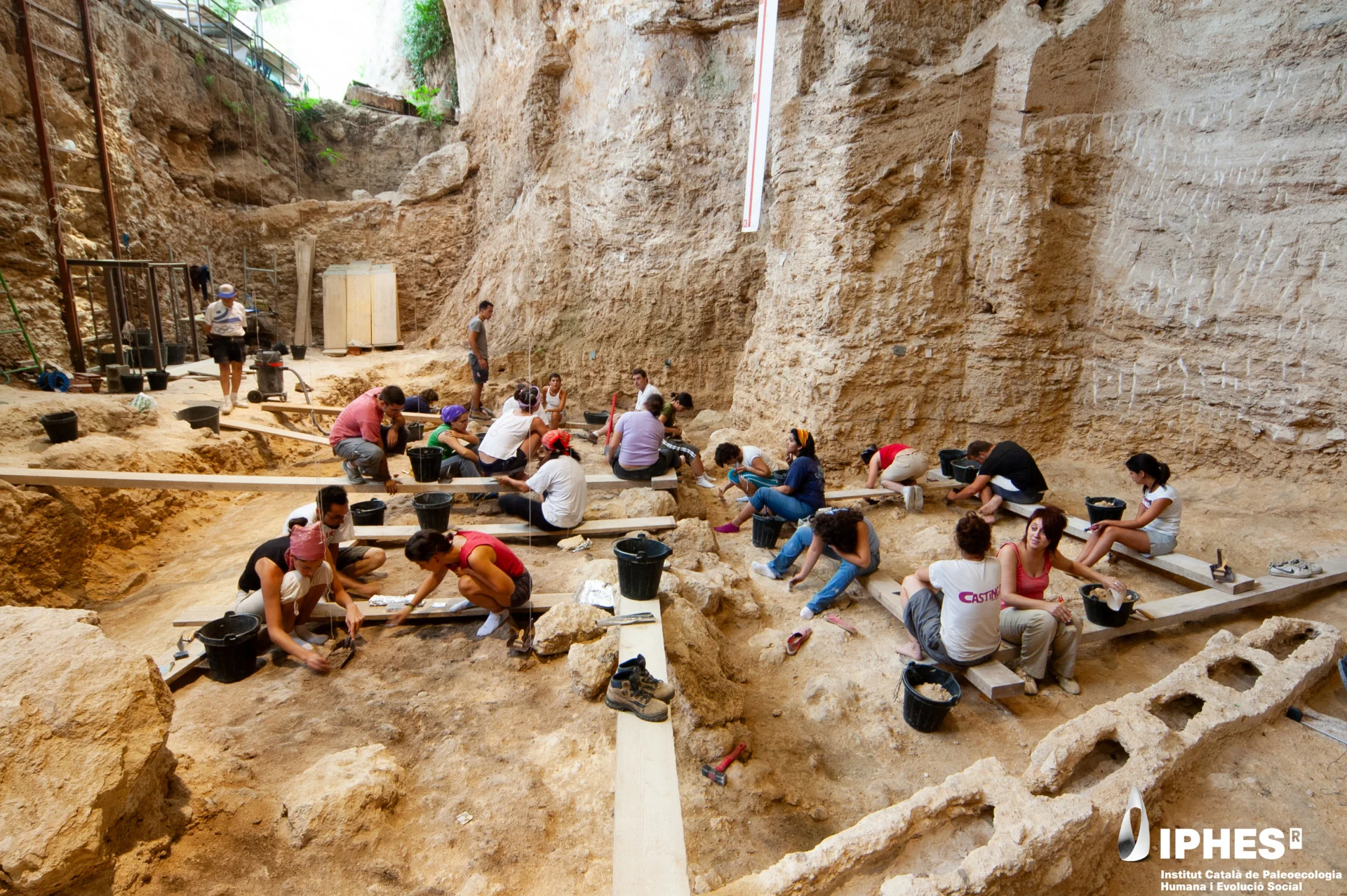
As one of our closest ancient human relatives, the Neanderthals knew how to exploit natural resources for their benefit. That said, some Neanderthal tools survived the wear of time much better than others, so the archaeological record had a large wooden gap—until now.
In a Science Advances study published today, scientists report the first comprehensive analysis of wooden Neanderthal tools retrieved from Abric Romaní, an archaeological site near Barcelona, Spain. The collection added up to 597 wooden remains and imprints from roughly between 62,000 and 42,000 years ago. The team identified 13 objects that resemble spears and pointed items, bark containers, structural elements, and a club-like object. Although this is not the first time archaeologists have discovered wooden objects attributed to Neanderthals, the findings expand our knowledge of our relatives’ lifestyles.
“I think the main message is quite simple,” Josep Vallverdú, a study co-author and an archaeologist at the Catalan Institute of Human Palaeoecology and Social Evolution (IPHES-CERCA), told Gizmodo. “Wood was probably a much more important part of Neanderthal life than we normally see in the archaeological record.”
In many ways, archaeology is a race against time. This isn’t a fancy analogy—even now, objects of varying archaeological value are literally decomposing from existing for hundreds to hundreds of thousands of years. Some items tend to survive better than others, and while archaeologists can make educated guesses on the evolution of ancient technology, it’s not always possible to identify physical evidence to back their stories.
“Stone survives extremely well, so naturally stone tools dominate the archaeological record,” Vallverdú explained.
Source link





