
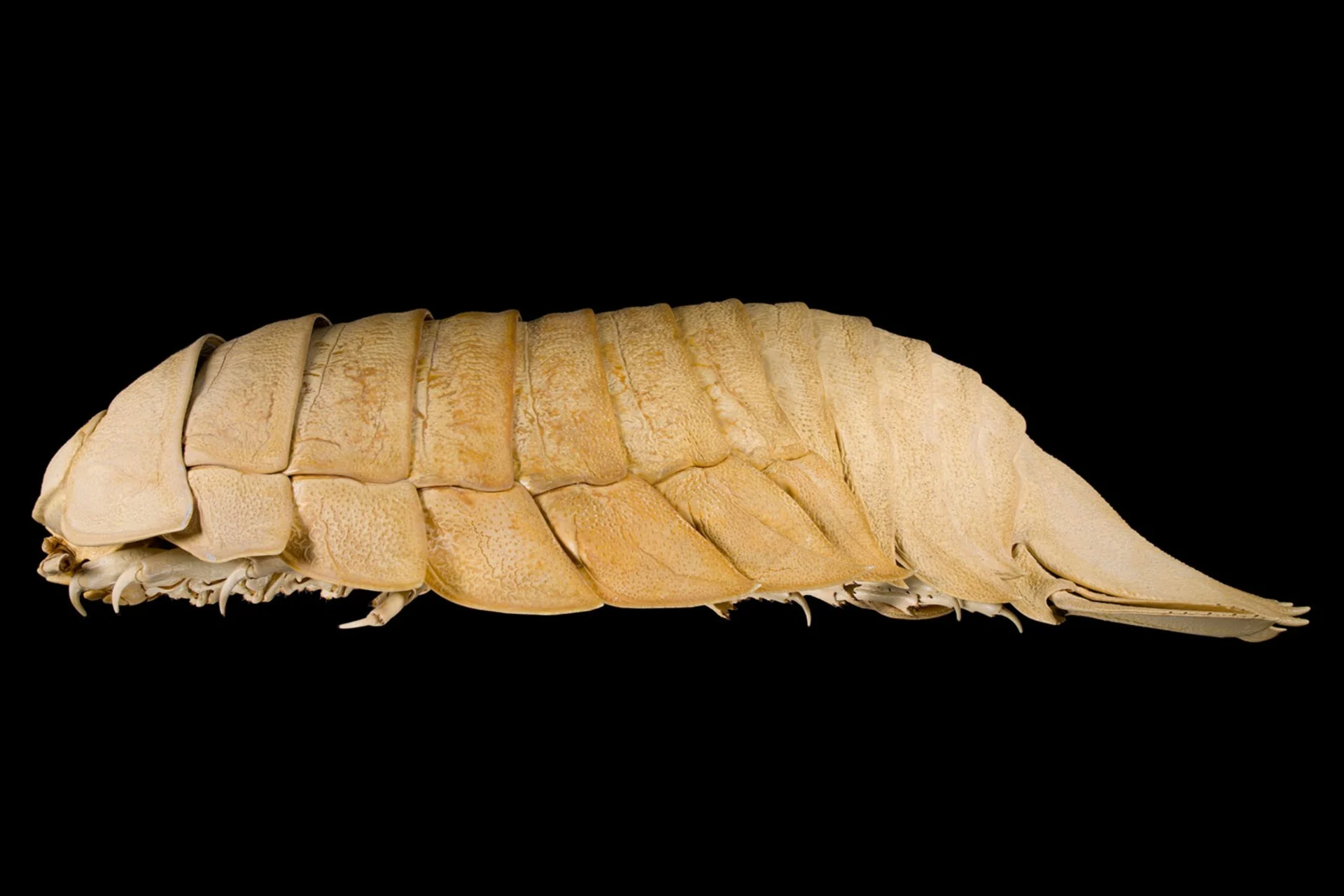
German paleontologist Dolf Seilacher had not yet won his Crafoord—the prestigious honor awarded by the same Swedish academy that gives out the Nobel Prize—when he was collecting specimens in Puerto Rico back in the 1980s. The research station had pulled a gigantic Bathynomus isopod, a huge bug-like crustacean roughly 12.7 inches (32.2 centimeters) long, up from a trap that had lain in wait 1,640 feet (500 meters) deep along the ocean floor.
Seilacher, sadly, passed away in 2014, long before he or anyone else realized that this specimen was actually representative of a previously unknown species. Now, over three decades after it was dredged up from the Caribbean, Tübingen paleontology student Benedikt Kästle and the curator of the university’s Paleontological Collection, Ingmar Werneburg, have finally given this creature a proper name. This roly-poly or pillbug-like giant isopod, long mislabelled as a Bathynomus giganteus has now been formally ID’ed under the brand new species name, Bathynomus tuebingoborikensis.
“The new species is very closely related to another giant species found off the Yucatán Peninsula in Mexico,” Kästle said in a statement, noting that this hefty isopod technically “falls into the category of ‘colossogiants.’”
To get even more technical, giant undersea isopods really do stem from the same order of crustaceans as woodlice, like the tiny brickwork woodlouse ( Porcellio spinicornis ) seen skulking around masonry and stonework across Europe and North America. 6 inches (10 and 15 millimeters) long, species from the gigantic Bathynomus genus can reach up to 20 inches (50 centimeters)—making them some of the largest invertebrates on Earth.
Source link





