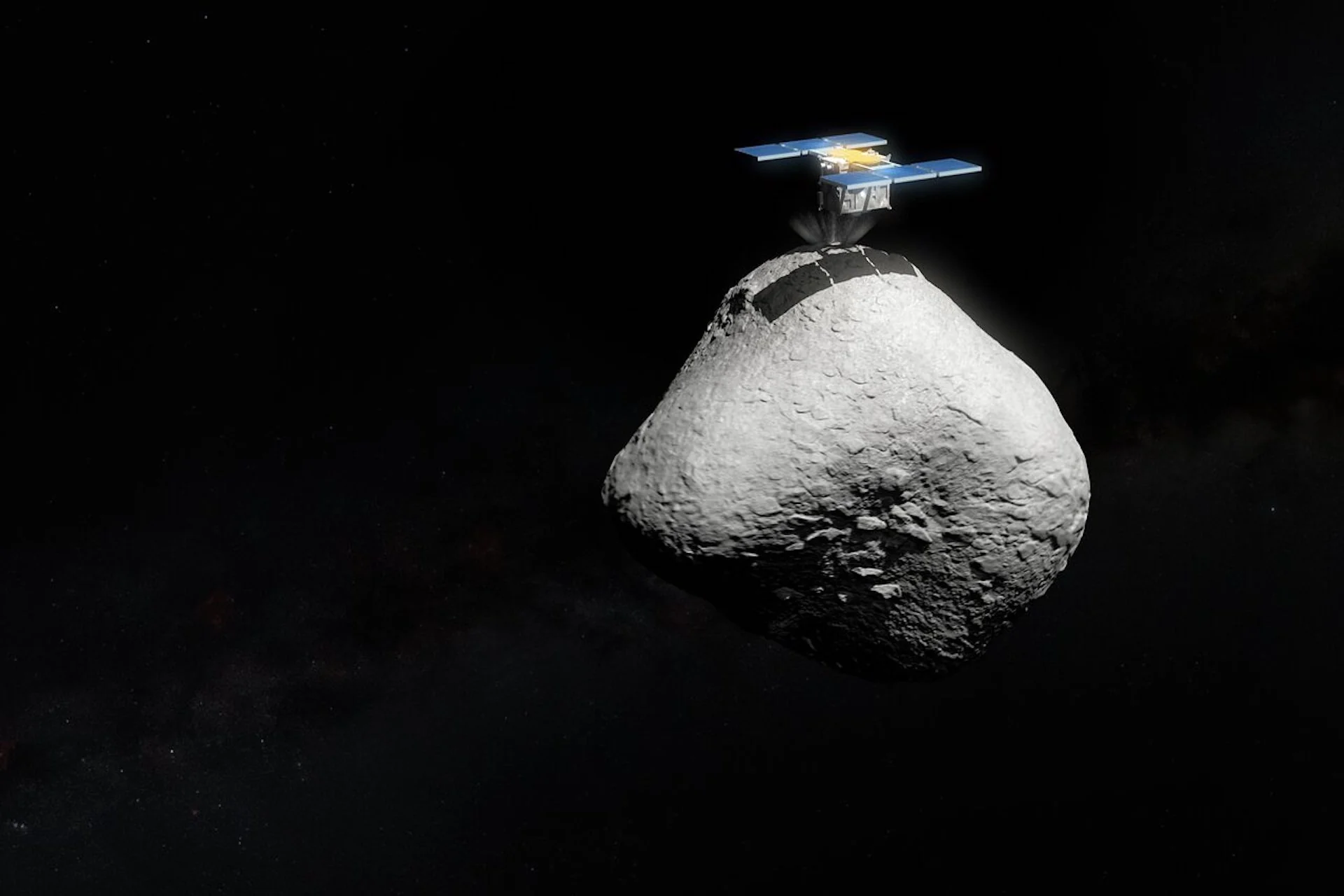
On December 6, 2020, Japan’s Hayabusa2 probe dropped a capsule of precious samples from asteroid Ryugu into the Australian outback, then set off on an extended mission that will end at a much smaller space rock. Its next encounter may prove more challenging, however, as the new target is moving in ways scientists still can’t explain.
The object, designated 1998 KY26, is accelerating in a way that cannot be accounted for with gravity alone. This has led some scientists to suggest that it’s not an asteroid but rather a dark comet or even an alien artifact (a theory we’re not going to entertain, at least for the time being). Now, a new paper challenges the idea that it’s a comet, finding that the space rock is too warm to hold on to buried ice.
The findings, published in the journal Icarus, reignite the mystery surrounding 1998 KY26 as the Japanese spacecraft races toward the unknown.
Hayabusa2 is set to rendezvous with the space rock in 2031 as part of its extended mission to collect more dust and rock straight from the source. 1998 KY26 is a small, lumpy near-Earth object that rotates so quickly that a day on the rock ends almost as soon as it begins.
Things have not been looking good for the mission for a while now. In a previous paper published in 2025, astronomers revealed that Hayabusa2’s new target is about a third the size previously estimated and spinning much faster than originally thought. Hayabusa2’s first target measures nearly 3,000 feet (900 meters) wide.
Source link