Scientists in Germany have just presented a new diamond-based quantum sensor that could let people with paralysis control robotic exoskeletons with nothing but the power of their minds.
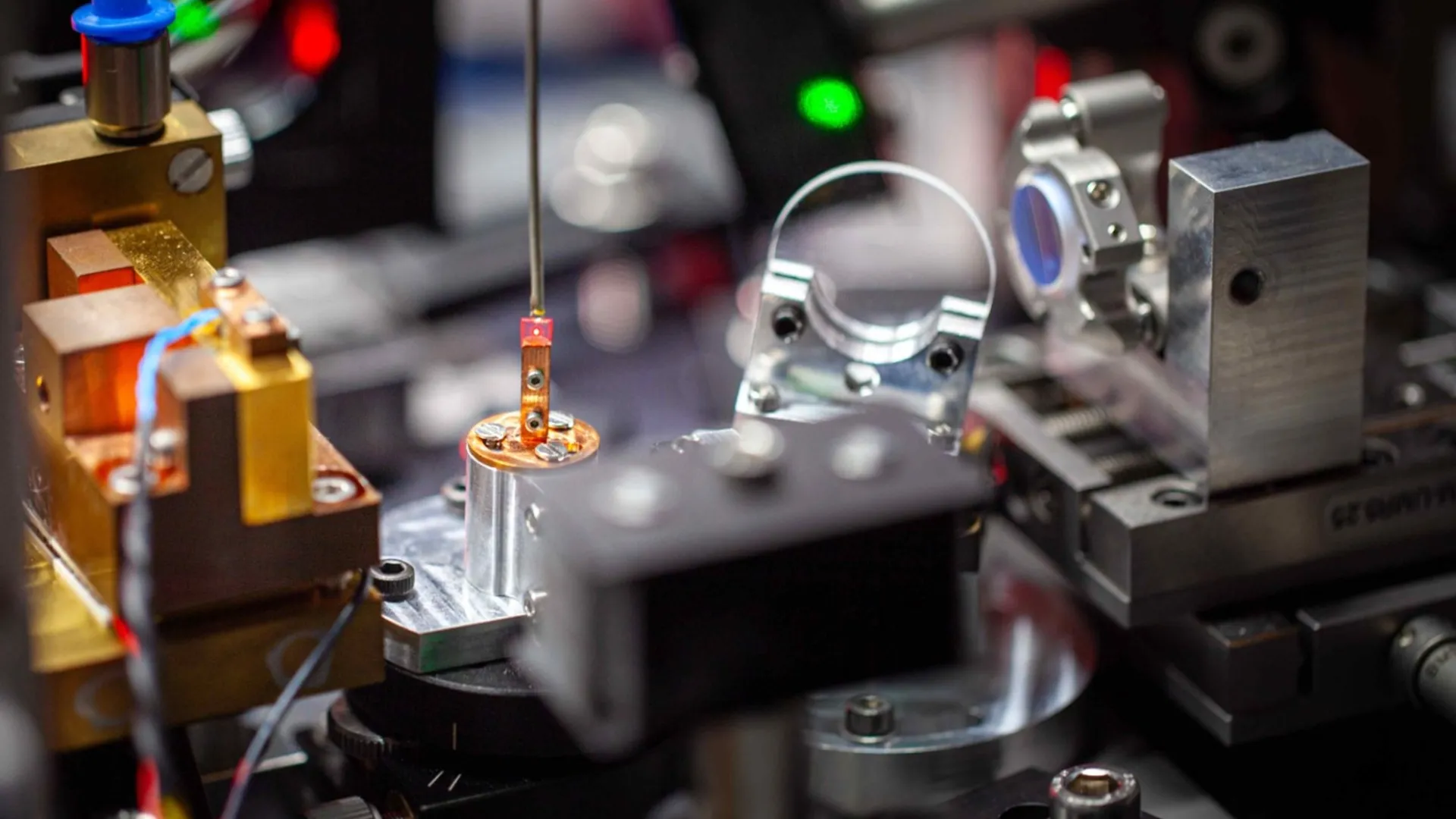
Developed by a research group at the Fraunhofer Institute for Applied Solid State Physics IAF in Freiburg im Breisgau, the sensor uses a laser system to detect weak magnetic fields with high sensitivity. It achieved 100 percent optical contrast and improved the balance between sensitivity and measurement range by a factor of up to 590 compared with existing technologies.
The effort was led by Jan Jeske, PhD, a researcher at Fraunhofer IAF. Jeske, who heads the Quantum Sensing Group at Fraunhofer at the research institute, was the the first to come up with a theoretical model for a magnetic-field-sensitive laser system using diamond with nitrogen-vacancy (NV) centers a decade ago.
“I am very pleased that we have now experimentally demonstrated the magnetic-field-dependent shift in the lasing threshold,” Jeske explained. The sensor could have applications in brain-computer interfaces, medical testing, navigation, and resource exploration.
Sensors that detect very weak magnetic fields have a limited measurement range. At the same time, those with a wider range are generally less sensitive. This is why the team created a technique called laser threshold magnetometry.
It relies on NV centers, which are, in essence, tiny defects in diamond crystals that respond to magnetic fields. An NV center forms when a nitrogen atom replaces a carbon atom in a diamond, leaving a neighboring spot empty.
Conventional diamond quantum sensors measure fluorescent light that is emitted by these defects.
Source link