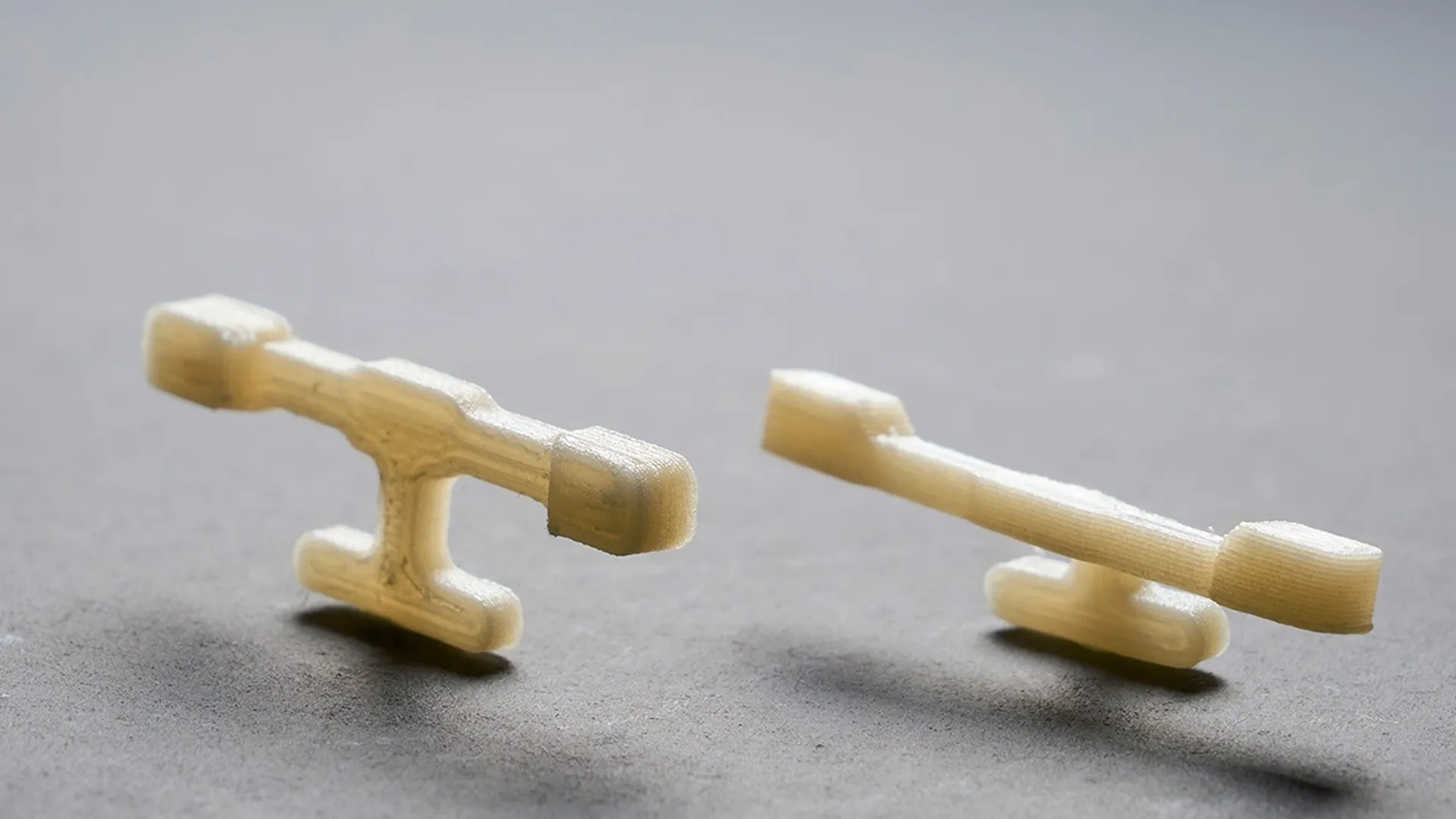
Researchers at Germany’s Fraunhofer Institute for Applied Polymer Research (IAP) have developed 3D-printed shape-memory polymer hinges that could help satellites deploy their solar panels while carrying significantly less mechanical hardware.
Each hinge weighs approximately 1.4 grams, making it about 93 percent lighter than conventional hinges currently used in satellite systems, according to the researchers. The components use heat to trigger a programmed shape change, allowing folded solar panels to unfold after launch.
The development is part of the Additive Manufacturing of Solar Panels for spACE applications (AM-SPACE) project, which brought together Fraunhofer IAP, German Orbital Systems (GOS), Orion Additive Manufacturing and the Fraunhofer Institute for Reliability and Microintegration IZM.
The technology uses shape-memory polymers (SMPs), materials that can be programmed into a temporary shape and recover their original form when heated.
Researchers processed the polymers into filaments suitable for additive manufacturing and used them to produce hinges and hold-down and release mechanisms (HDRMs). The latter keep satellite components secured during launch before releasing them in a controlled manner once the spacecraft reaches orbit.
After the release mechanism activates, the polymer hinges use heat to unfold the solar panels. A heating element raises the hinge’s temperature from 73.4°F to 284°F, triggering its programmed shape recovery. Under controlled laboratory conditions, the hinge completes deployment in about 60 seconds.
The approach could reduce the need for conventional mechanical actuation systems, which add weight and complexity to satellite deployment structures.
The researchers also used additive manufacturing to simplify the production of the components. Printing a hinge or an HDRM takes approximately 15 minutes, followed by another 30 minutes to program its temporary shape.
Source link