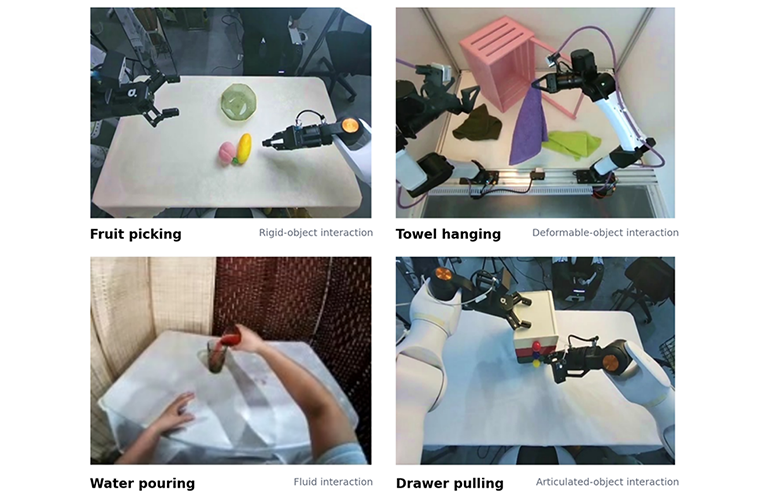
In one WorldOracle case, the robot’s grasp missed, yet the world model predicted a successful pick. Credit: [WorldOracle team / AgiBot]
Given the initial frame and action sequence of a real manipulation episode, the model generated a rollout that looked plausible on screen but differed from the actual execution. The success it depicted never happened in reality.
Researchers from Princeton University, the University of Texas at Austin, the University of Toronto, NVIDIA and AgiBot have jointly introduced WorldOracle, a benchmark specifically designed to evaluate action-conditioned world models (ACWMs) by comparing their predictions with real-world executions that start from the same initial observations and follow the same action sequences.
The team evaluated seven representative models — among them DreamDojo, Cosmos 3, IRASim and GE-Sim 2.0 — and identified two prominent problems. First, while the motion paths of robot arms are predicted relatively well, the positions and movements of manipulated objects can still deviate from reality. Second, models that perform well over short horizons can degrade significantly over complete operation sequences.
On October 16, WorldOracle, an evaluation platform for action-conditioned world models, officially opened to developers. The research team has collected real manipulation episodes in advance, recording both video and actions. Developers use the initial frames and action sequences provided in the evaluation set to generate predicted videos and submit them to the platform, which scores each submission against the corresponding real execution record. The results show whether a model has accurately predicted the consequences of the actions, helping developers pinpoint weaknesses and verify improvements.
Source link