This article has been reviewed according to Science X's editorial process and policies. Editors have highlighted the following attributes while ensuring the content's credibility:
Humanoid robots, robotic systems with a body shape that resembles that of humans, could tackle various chores and everyday manual tasks. To successfully complete these tasks, however, the robots should be able to reliably coordinate their movements, posture and how they touch or grasp different objects.
Human demonstrations of how to complete a task could offer valuable guidance that humanoids could follow. However, collecting human demonstration data that could be helpful for training robotics algorithms can be challenging.
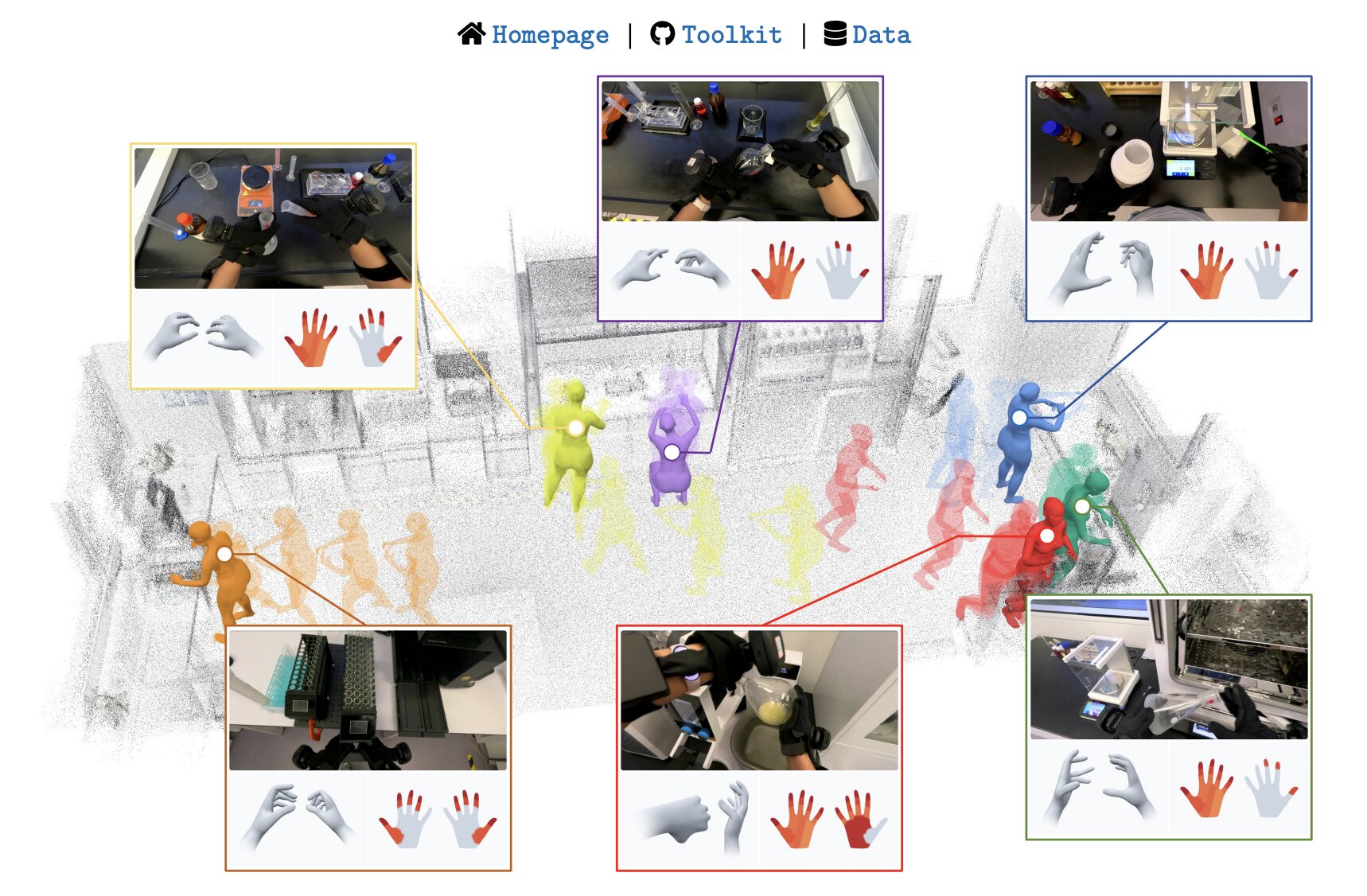
Researchers at the Shanghai AI Laboratory, Zhejiang University and Shanghai Jiao Tong University recently compiled a dataset containing 100 hours of human activity recorded with a new wearable system. The approach used to create the dataset, presented in an arXiv preprint, combines video from a wearer's viewpoint with reconstructed body movements, recorded finger movements, available tactile data and descriptions of individual task steps.
"Learning humanoid loco-manipulation from human demonstrations rests on observing how locomotion, posture, and object interaction evolve together as tasks unfold," Yunsong Zhou, Xuekun Jiang and their colleagues wrote in their paper. "Scaling collection across diverse environments, in turn, favors lightweight, portable capture systems. Yet, existing datasets provide only partial views of this coordination."
Zhou, Jiang and their colleagues developed a new wearable system that can capture data while humans are completing different activities. This system combines a head-mounted GoPro HERO13 camera with five VIVE Ultimate Trackers, sensor-equipped MANUS Metagloves or Wuji gloves, and custom 3D-printed mounts and straps.
Source link