This article has been reviewed according to Science X's editorial process and policies. Editors have highlighted the following attributes while ensuring the content's credibility:
A robot arm that bends like an elephant's trunk can slip into tight spaces and handle fragile objects. Controlling it is harder because its smooth bending makes its next move hard to predict. Researchers have now developed a method that keeps computer predictions of the arm's motion on track, even when the arm moves faster than the model was trained for.
The study comes from a team involving professors Xie Guangming and Zhang Feitian at Peking University's School of Advanced Manufacturing and Robotics. It was presented at Robotics: Science and Systems (RSS 2026), which was held in Sydney from July 13 to 17, 2026.
It is now published in the conference proceedings Robotics: Science and Systems XXII, and details of the project are available on the project website.
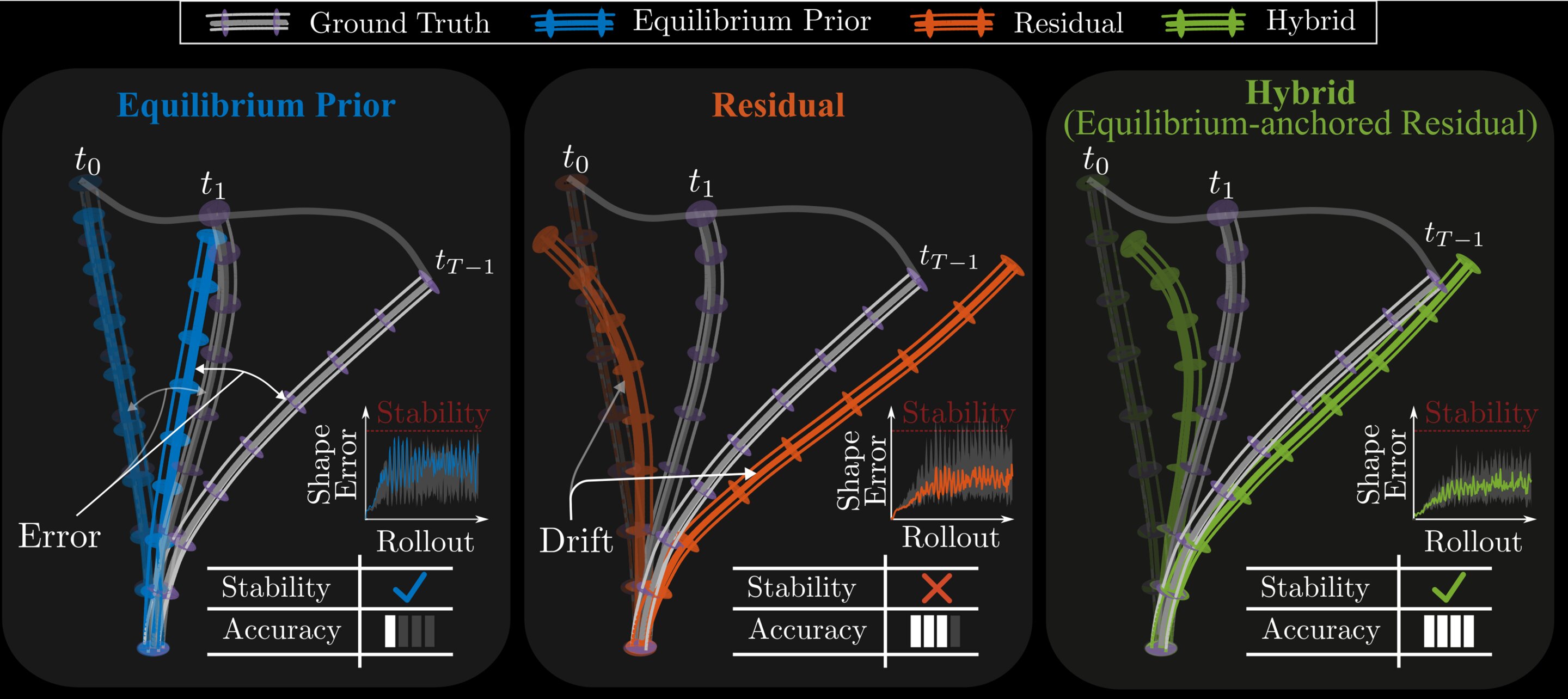
Before a flexible robot moves, its controller often rehearses possible commands in a computer model and picks the best one. Models trained on data predict one small step at a time, and each step starts from the last, so small errors pile up. After 200 steps, the forecast can be far off, and the robot can be working from a false picture of its own body.
The team's idea is to give the forecast a reference point. One model, the anchor, learns the shape the arm settles into whenever its controls are held steady.
Source link