This article has been reviewed according to Science X's editorial process and policies. Editors have highlighted the following attributes while ensuring the content's credibility:
Research published in the International Journal of Manufacturing Research shows that "haptic," vibration-based feedback in virtual reality (VR) can help users understand collaborative robots and improve safety controls. However, in a pilot study researchers found no measurable improvement in the actual efficiency with which a task was carried out.
Collaborative robots can work alongside humans to improve manufacturing precision and flexibility but require users to understand their operating limits. The safety system examined automatically stops the robot when its speed exceeds a predefined threshold, potentially interrupting work.
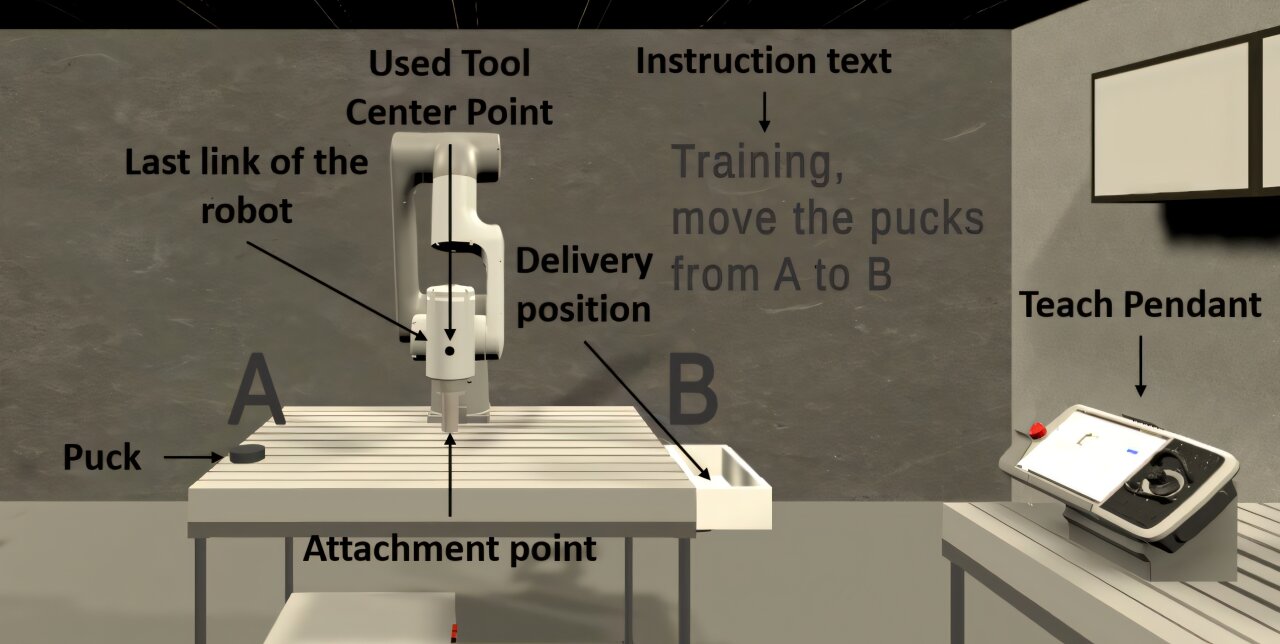
The study investigated whether haptic feedback delivered through VR handheld controllers could help people work alongside virtual robots. The vibrations varied in intensity according to the robot's speed, signaling when it was approaching its safety limit. This served as an early warning for the human operators.
Tests were done with 30 participants completing a pick-and-place task under three conditions: no vibration, constant vibration and variable vibration, each setting linked to the robot's speed. Half of the participants received information about the safety system and feedback signals, together with procedural guidance, while the other half received minimal information.
The findings thus suggest that haptic feedback might improve the user experience and safety when co-working with a robot but without necessarily improving performance.
, Human-robot collaboration in virtual reality: evaluating the effects of vibrotactile feedback and safety information on efficiency, International Journal of Manufacturing Research (2026).
Source link