This article has been reviewed according to Science X's editorial process and policies. Editors have highlighted the following attributes while ensuring the content's credibility:
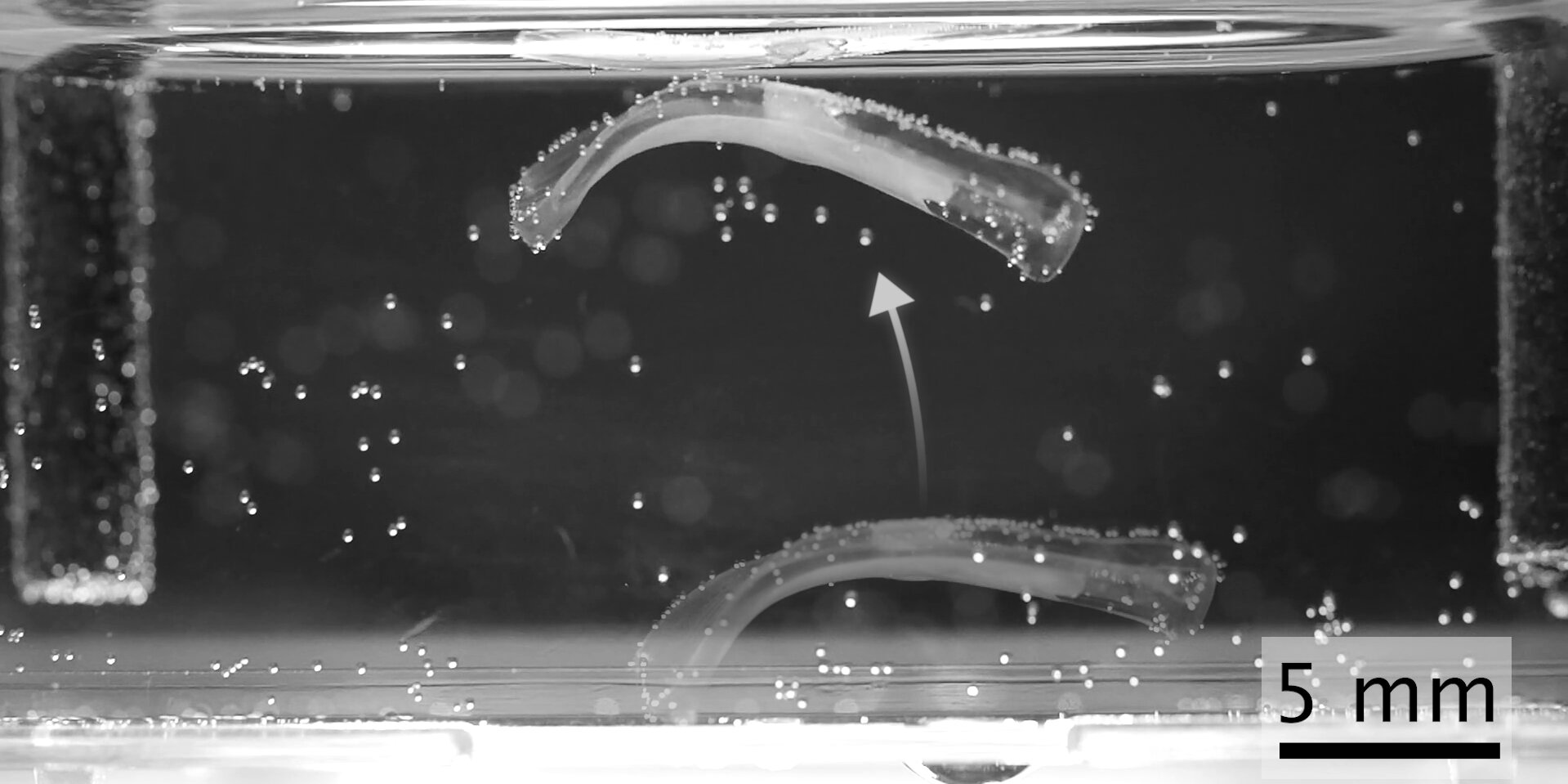
Lab-grown skeletal muscle tissue can contract, but the movement is often so slight that it is barely visible. This poses a problem for biohybrid robots designed to move using living muscles. Researchers at ETH Zurich have now demonstrated that it is not just the amount of muscle tissue that matters, but above all how the muscle and the artificial scaffold interact.
Their bioactuators combine living skeletal muscle tissue, grown from mouse muscle cells, with a soft hydrogel scaffold. This soft, water-rich material bends and stretches like living tissue. What is new is that both parts are designed together as one system. The researchers first used a computer simulation to determine where and how much muscle tissue to place and what properties the hydrogel scaffold should have.
Aiste Balciunaite and Mike Y. Michelis, co-lead authors of a study recently published in Nature Communications, jointly developed a new approach for this purpose. The muscle and the scaffold are designed together from the outset. Balciunaite, a doctoral student in the Soft Robotics Lab led by ETH professor Robert Katzschmann, explains: "Instead of specifying a fixed form for our muscle geometry, we wanted to design the whole thing from scratch on the computer."
To do this, the researchers designed the muscle tissue configuration and the scaffold simultaneously on the computer, rather than one after the other. An algorithm searched for configurations in which the contraction of the muscle produced the greatest possible movement of the entire component.
Source link