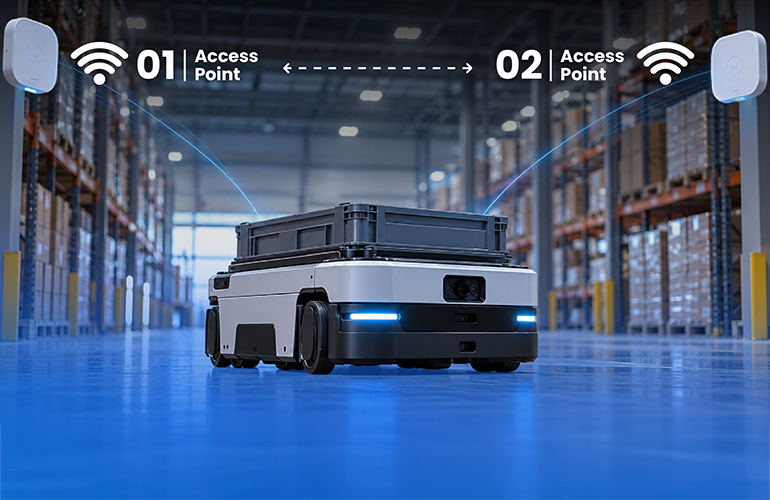
Wi-Fi connectivity needs to be reliable for real-time mobile robot management. Source: Synaptics
An autonomous mobile robot or AMR may cross dozens of Wi-Fi coverage zones during a single shift. Each transition creates a small but potentially consequential communications problem: How does the robot find its next access point without interrupting the connection it is already using?
The answer matters because AMRs, industrial inspection robots, warehouse automation, and healthcare service robots increasingly depend on continuous connectivity for sensor data, telemetry, and control.
In a conventional Wi-Fi architecture, the primary communication radio must periodically stop transmitting and receiving application traffic while it searches for alternative access points. That creates a tradeoff among connectivity, latency, power consumption, and roaming performance.
A dedicated scan architecture separates network discovery from application traffic. The robot can monitor its wireless environment continuously while the primary radio maintains the active connection.
One implementation, Synaptics Scan Core, uses a low-power wireless subsystem to monitor neighboring access points while the primary Wi-Fi radio remains dedicated to application traffic. This separation can support faster roaming decisions, lower latency, reduced packet loss, and more efficient scanning.
Robots are becoming more connected and autonomous across manufacturing, logistics, healthcare, retail, and service environments. As they move through larger and more complex facilities, reliable wireless connectivity and fast roaming become core design requirements rather than secondary networking considerations.
Unlike stationary Wi-Fi devices, robots move continually between coverage areas while maintaining video, AI inference, telemetry, and fleet-management communications. These combined demands make mobile robotics a strong use case for dedicated scanning architectures.
Source link