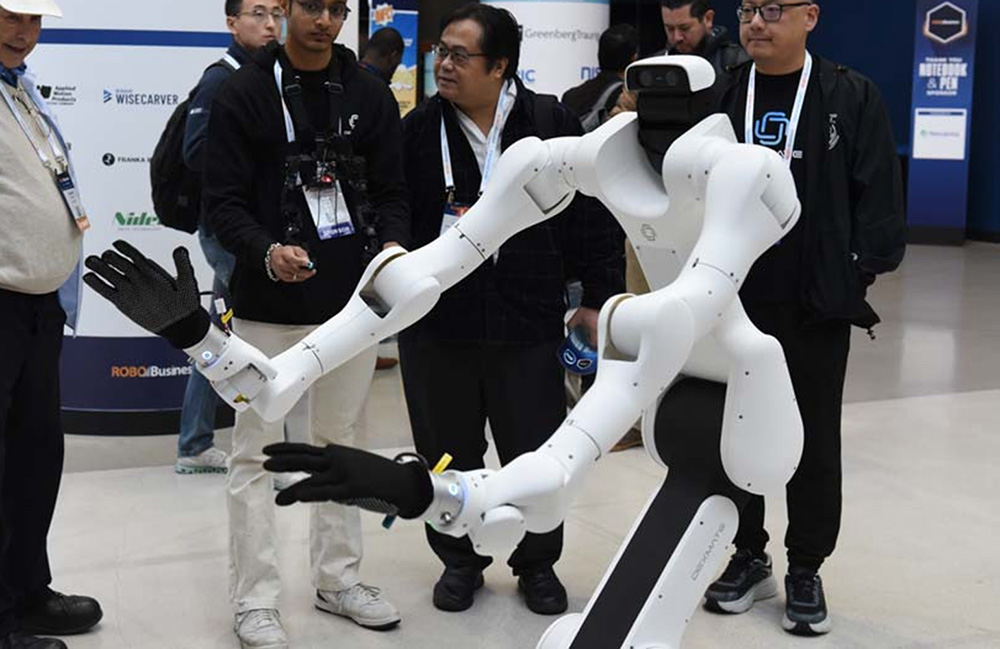
Vision has become central to modern robotics, but cameras alone cannot tell a robot everything it needs to know about physical contact. When handling flexible objects, inserting components, or manipulating delicate items, robots need information about forces, slippage, and contact that visual systems may miss.
Daimon Robotics wants to provide the infrastructure to help robots develop that capability.
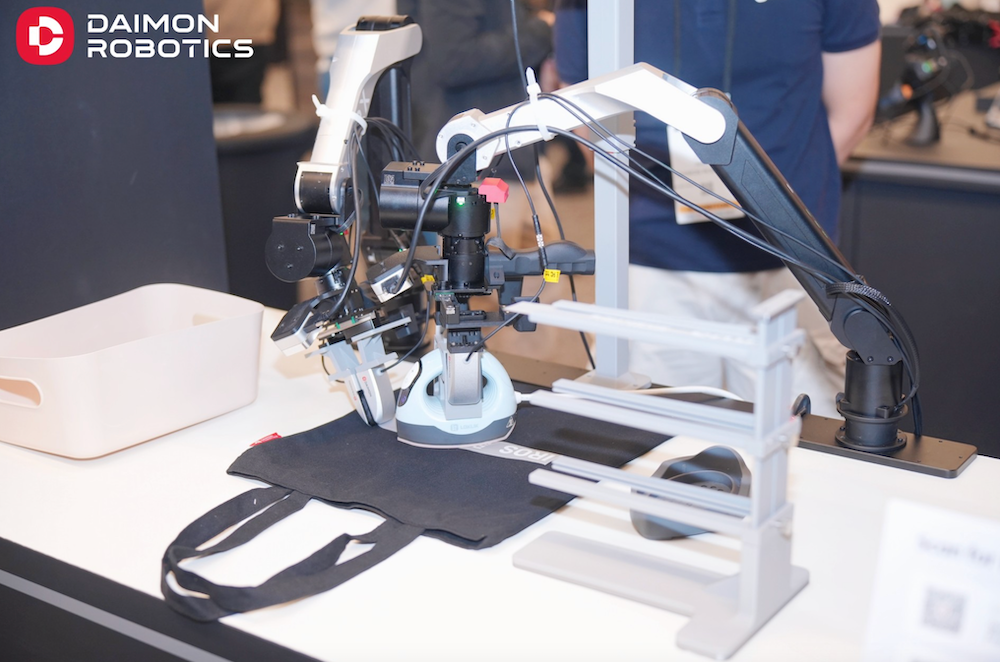
Rather than focusing exclusively on tactile sensors or developing a single foundation model, the company is building a pipeline that connects tactile sensing, data collection, simulation, and AI models. Its goal is to turn physical interactions into useful training data that helps robots perform manipulation tasks more reliably.
“By building tactile intelligence, we’re actually playing the role as an infrastructure provider,” Daimon’s Partner & VP of Technology Dr. Zhu told The Robot Report. “We’re not aiming to be a foundation model developer. We are providing the infrastructure for doing so for those downstream customers.”
That distinction is central to Daimon’s strategy: develop the tools and data infrastructure that other companies can use to build more capable robotic systems.
Collecting useful tactile data at scale presents a challenge. Unlike visual data, which can be captured relatively easily with cameras, tactile data depends on physical contact. The resulting information varies with an object’s material, geometry, the forces applied, and the task being performed.
Daimon is developing a pipeline to capture and process these interactions, with tactile feedback operating at 30 Hz. The company is also working to connect real-world data with simulation, allowing physical interactions to inform training in virtual environments.
Source link