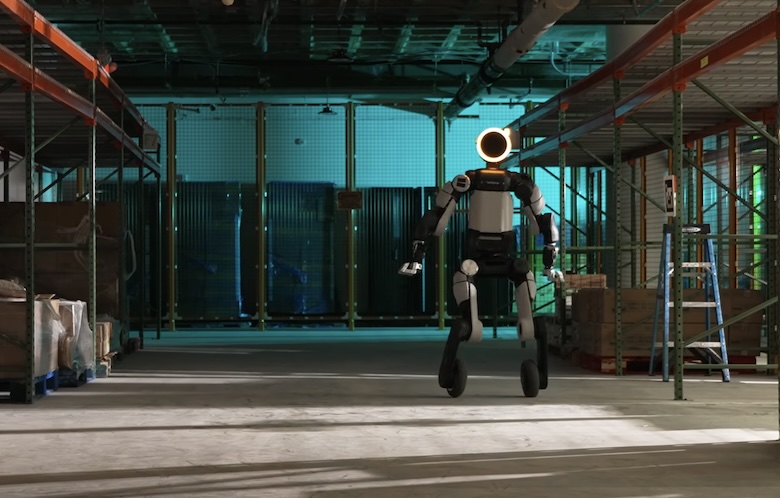
Bridging the divide between deterministic physics-based control and policy-driven adaptation, Boston Dynamics released a video today showing its Atlas humanoid using wheels to move around. The “experiment” combined classical model-based motor control with whole-body reinforcement learning to maintain dynamic stability across unstructured, real-world terrain.
In the video, Andy Wu, controls engineer for Atlas at Boston Dynamics, highlights some recent experiments that he executed by attaching wheels to Atlas’ legs. Boston Dynamics said “a wheeled Atlas isn’t a product. It’s a research testbed.” Wu’s intention was to push the actuation to its limits.
Another goal of the experiment was to understand unstructured environment adaptability. Wu addresses the limitations of purely model-based control when navigating unpredictable, real-world conditions that are difficult to model or simulate.
Through a whole-body reinforcement learning (RL) policy, Atlas demonstrates that it can process real-time proprioceptive feedback and velocity commands. The experiment also outputs dynamic pose and force adjustments to mitigate unmodeled disturbances and non-ideal contact states.
Boston Dynamics attached wheels to the feet of the Atlas humanoid for a set of controls engineering experiments. | Credit: Boston Dynamics
In addition to learning how to move with wheels for feet, Atlas also performs pirouettes and various aggressive actuation maneuvers.
This demonstrates that Atlas can smoothly switch between fast rolling on flat terrain and articulated legged motion over obstacles or irregular surfaces.
Wu trained the system in sim. The system learned all of the behaviors in sim and executed them in real life, with surprising accuracy, according to Wu.
Source link